July 27, 2026
PetSafe® Expert
PetSafe® Guest
Pet Travel Safety Tips: The Complete Guide for Dogs and Cats
Key Points
- The single most important travel decision is whether to travel with your pet at all. If your trip is short and a trusted sitter is available, staying home is often the safest choice for many pets, especially cats. [1]
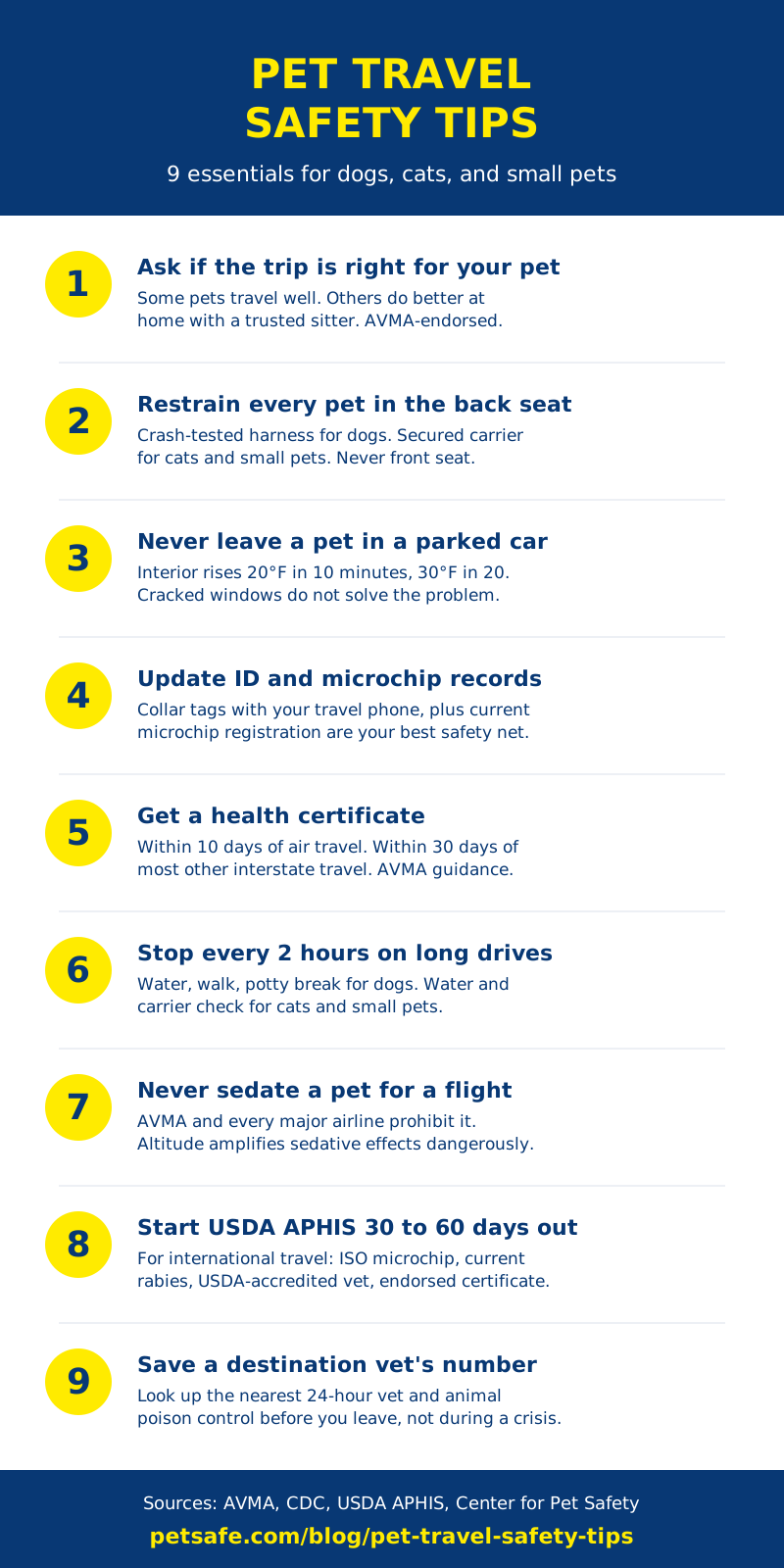
- The safest position for any pet in a moving vehicle is properly restrained in the back seat: a crash-tested harness or crate for dogs, a secured carrier for cats and small pets. Unrestrained pets are a hazard to themselves and to every human in the car. [2][3]
- Never leave a pet in a parked vehicle. AVMA research shows the interior temperature can rise about 20°F in 10 minutes and nearly 30°F in 20 minutes. At one hour, the interior can be more than 40°F hotter than outside. Cracked windows do not solve the problem. [3][4]
- For interstate air travel, most airlines require a Certificate of Veterinary Inspection issued within 10 days of travel. For interstate travel by car, the AVMA guidance is generally a certificate issued within 30 days. International travel requires USDA APHIS endorsement and country-specific rules that can take 30 to 60 days or longer to complete. [1][5]
- Sedatives are dangerous for air travel and are not recommended by the AVMA or any major U.S. airline. For pets with severe travel anxiety, work with your veterinarian on non-sedating alternatives before the trip. [1]
Traveling with a pet is different from traveling alone. Every trip becomes a two-step process: what you need, and what your pet needs. And what a pet needs on the road is often the opposite of what makes for a smooth vacation for humans: consistency, control, familiar smells, and predictable timing.
The good news is that pet travel is very doable when you prepare. Millions of pets travel by car, plane, and across borders every year. The difference between a smooth trip and a stressful one is not about the destination. It is about knowing what your specific pet needs, whether to bring them at all, and how to keep them safe when you do.
This guide covers pet travel safety tips that apply to any pet, along with the essentials for dogs, cats, and small pets. It is grounded in current guidance from the American Veterinary Medical Association, the Centers for Disease Control and Prevention, the USDA Animal and Plant Health Inspection Service, the American Association of Feline Practitioners, and the Center for Pet Safety.
For species-specific deep dives, see our companion guides on how to travel with a dog and how to travel with a cat.
Table of Contents
- The Three Questions To Ask Before Any Pet Trip
- Universal Car Safety: What Every Pet Needs
- Never Leave a Pet in a Parked Car
- Traveling With a Dog: The Essentials
- Traveling With a Cat: The Essentials
- Traveling With Rabbits, Birds, and Other Small Pets
- Air Travel With Any Pet
- Interstate and International Travel
- The Universal Pet Travel Packing List
- Emergency Prep: If Your Pet Gets Lost
- Frequently Asked Questions
- Citations and sources
The Three Questions To Ask Before Any Pet Trip
The most important pet travel safety tip is the one that happens before you leave the driveway. Not every trip is right for every pet. The AVMA is explicit about this: "Before putting your pet in your vehicle, ask yourself if you really need to take the animal with you. If the answer is no, leave your pet safely at home." [3]
Ask yourself three questions:
- Is my pet physically ready? Talk to your veterinarian about age, health, joint mobility, respiratory conditions, and any medications. Senior pets, very young pets, pregnant animals, brachycephalic (flat-faced) breeds, and pets with heart, kidney, or respiratory disease often do worse with the stress of travel. Federal regulations require dogs and cats to be at least 8 weeks old and weaned for at least five days before flying. [1]
- Is my destination pet-friendly? Verify that your hotel, rental, family's home, or campsite is safe for your specific pet. Ask about screens on windows, escape routes, resident pets, toxic houseplants, size and breed restrictions, and quiet spaces where a stressed pet can retreat.
- Is a trusted sitter or boarding option available? Some pets travel well. Others do not. For cats especially, a reliable in-home sitter often produces less stress than any trip. For dogs, a familiar boarding facility or a live-in sitter can be a safer choice than a difficult multi-day drive or a stressful flight. Leaving a pet at home is not a failure. It is a decision that prioritizes what your pet actually needs.
If the answer to all three questions is yes, you are ready to plan. If any answer is no, adjust the plan.
"Before putting your pet in your vehicle, ask yourself if you really need to take the animal with you. If the answer is no, leave your pet safely at home." [3]
American Veterinary Medical Association, Pet Safety in Vehicles
Schedule a Pre-Travel Veterinary Visit
For any trip beyond a short local drive, schedule a veterinary appointment 30 to 60 days before departure. This visit should cover:
- General health check to confirm your pet is fit for travel
- Vaccinations up to date, including rabies (required for essentially all interstate and international travel)
- Flea, tick, and heartworm prevention current for your destination
- Certificate of Veterinary Inspection (also called a health certificate) if you are crossing state lines or flying. Most airlines require this within 10 days of travel. AVMA guidance for other interstate travel is generally within 30 days. [1]
- Motion-sickness or anti-anxiety medication if your pet has struggled with travel before. Trial any medication at home before the trip so you know how your pet responds.
- Microchip registration current with your travel phone number added
Universal Car Safety: What Every Pet Needs
Car travel is where most pets spend their travel time. The AVMA's position on car safety applies to every pet, regardless of species: it is unsafe for pets to be loose inside motor vehicles. [2]
The Back Seat, Every Time
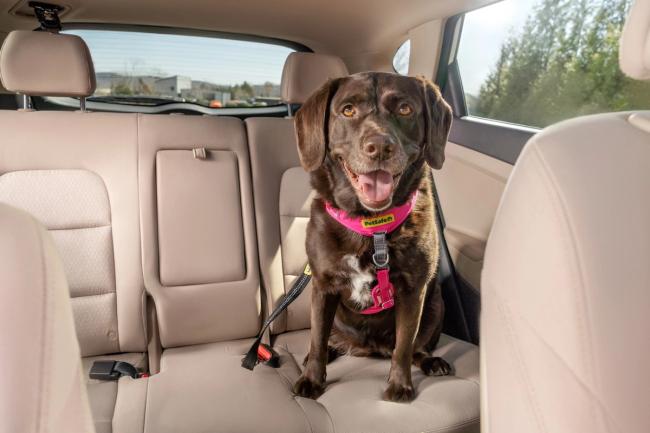
The safest position for any pet in a moving vehicle is the back seat, properly restrained. The reasoning is the same as it is for a small child: airbags are designed to protect adult humans in a collision, and the deployment force can seriously injure or kill a pet in the front seat, even one wearing a harness. [3]
Beyond the airbag risk, unrestrained pets in the front are a top source of driver distraction. A small pet can crawl into the footwell and interfere with the brake or accelerator. A larger pet can lean across your lap and block your view of the road. In a collision, an unrestrained pet becomes a projectile that can injure the driver, other passengers, and themselves. [3]
Choose the Right Restraint for the Pet
Every pet needs a restraint, but the right restraint depends on the species and size:
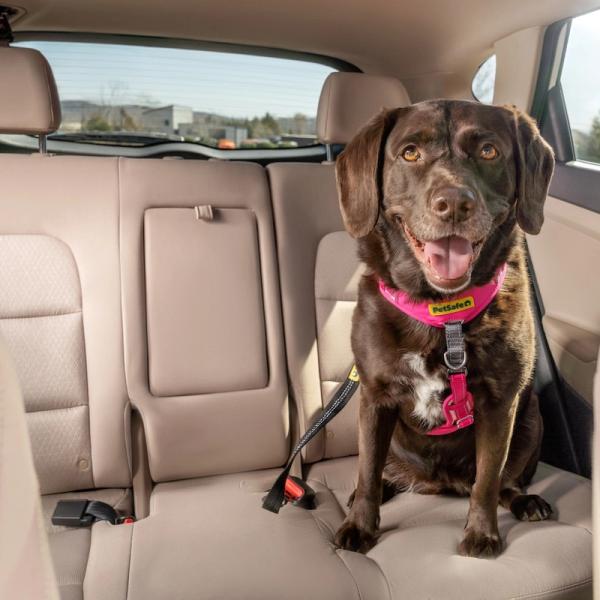
- Dogs: crash-tested harness or crate. Look for products independently crash-tested by the Center for Pet Safety, which uses a protocol adapted from Federal Motor Vehicle Safety Standard 213, the same standard used for child safety seats. Only a small number of harnesses and crates have earned CPS certification. For a full breakdown, see how to travel with a dog. [6]
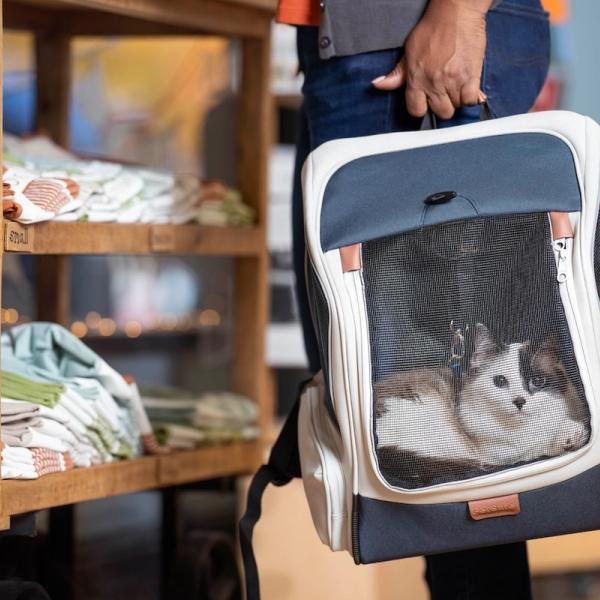
- Cats: secured hard-sided carrier. Cats should always be in a carrier when traveling. Secure the carrier with the seatbelt on the back seat, or wedge it on the floor behind the front seat so it cannot slide or tip. For carrier training and long-distance car trips, see how to travel with a cat. [7]
- Small pets: secured carrier appropriate to species. Rabbits, guinea pigs, small mammals, and birds all need a properly ventilated carrier, secured to prevent sliding or tipping. Cardboard carriers are generally not safe for rabbits, who can chew through them in minutes. [8]
Position the Carrier Correctly
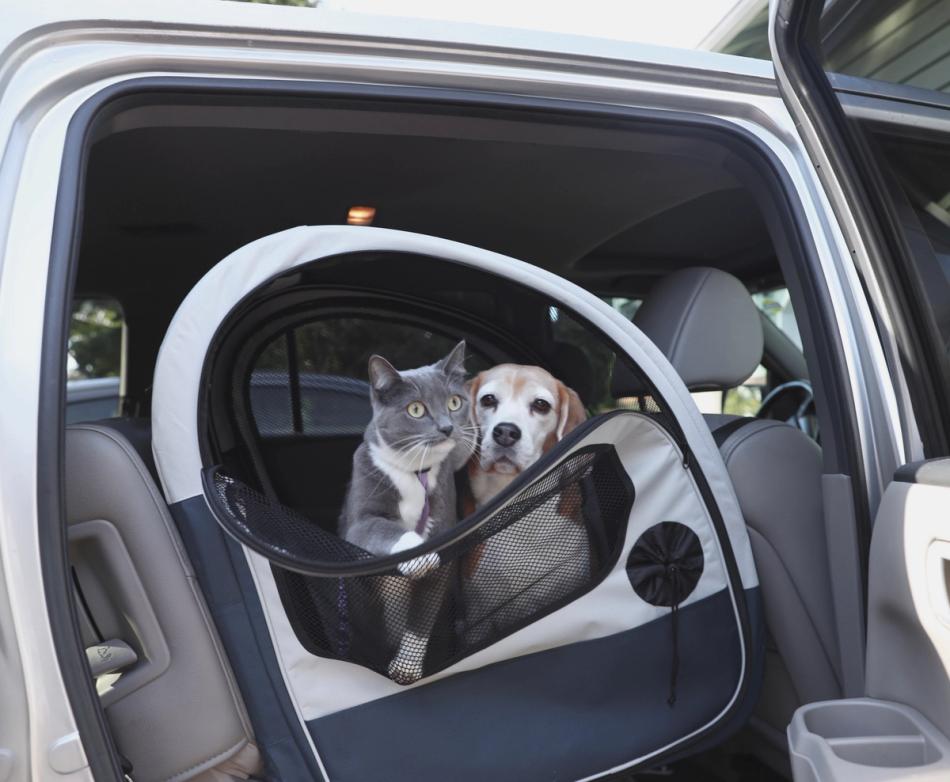
AVMA guidance is to position the crate or carrier as near to the center of the vehicle as possible and secure it to prevent movement. [3] The carrier should not shift when you brake hard. Never place a carrier in the front seat where an airbag could crush it in a collision, and never place it on the driver's side floor where the driver could interfere with it.
Steady Driving Matters
Sudden braking, sharp turns, and aggressive acceleration all worsen motion sickness and increase the risk of a carrier tipping. Drive as if you have a full cup of coffee on the dashboard. Steady, smooth driving is one of the highest-impact pet travel safety tips and costs nothing.
Never Leave a Pet in a Parked Car
This is the rule that has to survive every travel plan, every errand, every "I'll only be five minutes." The AVMA reports that hundreds of pets die every year from heat exhaustion after being left in parked vehicles. [3]
The physics are dangerous even on days that do not feel that hot:
- Interior temperature rises about 20°F in 10 minutes
- Rises almost 30°F in 20 minutes
- At one hour, the interior can be more than 40°F hotter than outside
- On a 70°F day, that means more than 110°F inside the vehicle [3]
- On an 80°F day, the interior can reach 114°F in 30 minutes [4]
Cracking the windows does not solve it. Parking in the shade does not solve it. Leaving the air conditioning running unattended risks the engine cutting out or the car being stolen. The only safe option is to not leave a pet in a parked car at all.
Cold weather is also dangerous. Leaving a pet in a vehicle on a chilly day is not much better than leaving them outdoors. Small pets, senior pets, and pets with short coats are especially vulnerable to cold-related risks. [3]
If you must stop for food, gas, or a bathroom break during a road trip, one person stays with the pet with the engine and climate control running, or the whole family gets out together and the pet returns to an indoor space. For more on heat-related emergencies, see our guide on how to spot and prevent heat stroke in dogs.
Traveling With a Dog: The Essentials
Most dogs love the ride, but every dog has different needs based on age, size, temperament, and health. Here are the essentials. For a full guide covering car, air, and international travel with a dog, see our full guide on how to travel with a dog.
Restraint
- Back seat only, with a crash-tested harness secured to the vehicle's seatbelt, or in a crash-tested travel crate anchored to the seat
- Never in an open truck bed. Unsecured dogs can jump or fall out at highway speeds, and dogs tied down with leashes can become dangerously entangled [2]
- Do not let a dog ride with their head outside the car window. Airborne dirt and debris can injure the eyes, ears, nose, and mouth [1]
Pit Stops on Long Drives
- Stop every 2 hours to let your dog walk, drink water, and relieve themselves [1]
- Leash before you open any door. Dogs can bolt in unfamiliar territory
- Check paw pads for hot pavement (a general rule: if you cannot hold the back of your hand on the pavement for 7 seconds, it is too hot for your dog)
Motion Sickness
Motion sickness is common in dogs, especially puppies whose inner ear balance apparatus is not fully developed. Prevention: feed a light meal 3 to 4 hours before travel (not right before), keep the car cool, drive steadily, and talk to your veterinarian about prescription maropitant citrate (Cerenia) for dogs who struggle even with the basics.
Traveling With a Cat: The Essentials
Cats are different travelers than dogs. Where a dog often wants to come along, a cat almost always wants to stay home. That is not a failure of temperament, it is biology. Cats are territorial, and travel disrupts the scent-marked environment they rely on for a sense of safety. For a full guide on carrier training, long-distance car trips, and settling in at your destination, see our companion guide on how to travel with a cat. [9]
Carrier Training First
The single biggest predictor of a smooth cat trip is whether your cat is comfortable in their carrier before the trip. Over 75% of cat caregivers report they have never received travel advice from their veterinarian, and the number one reason cats miss annual checkups is that their humans cannot get them into a carrier without a fight. Two weeks of carrier training changes that. [10]
- Leave the carrier out in your home all the time, with the door open or removed
- Line the bottom with a familiar-smelling blanket
- Drop treats inside every day, feed meals inside, and let the cat come and go freely
- Once the carrier is a safe space, generalize to short car rides before any long trip
In the Car
- Always in a hard-sided carrier, never loose
- Secure the carrier with the seatbelt on the back seat, or wedge it on the floor behind the front passenger seat
- Cover the carrier partially with a light blanket for a den effect
- Never place a carrier in the front seat where an airbag could crush it [3]
Long Trips
- Bring a disposable travel litter box with familiar litter
- Cats often will not eat or use the litter box in a moving car. Book cat-friendly overnight stops for trips over 8 hours
- Offer water at every pit stop. Stressed cats often stop drinking, and mid-trip dehydration compounds fast
Traveling With Rabbits, Birds, and Other Small Pets
Rabbits, guinea pigs, hamsters, ferrets, birds, and reptiles are more vulnerable to travel stress than dogs or cats. Their prey-animal instincts (in the case of small mammals and birds) or narrow temperature tolerances (reptiles) mean the same trip that a dog would handle easily can be dangerous for a small pet. Consider carefully whether the trip is right, and if it is, plan more conservatively.
Rabbits and Small Mammals
- Hard-sided carrier only. Cardboard carriers are not safe because rabbits and rodents can chew through them in minutes. Choose a carrier at least 2 to 3 times the size of the pet, with ventilation on multiple sides, and secure it with the seatbelt on the back seat. [8]
- Watch the temperature closely. Rabbits are highly heat-sensitive. Heat stress can occur at ambient temperatures above 86°F, and heatstroke above 95°F. Start the vehicle and cool it down before loading the pet, and avoid the hottest hours of the day. [11]
- Provide hydration and food during the trip. Line the carrier with a blanket and disposable pads. Include cold, wet leafy greens (rabbits often get much of their hydration from food), a small amount of hay, and access to water. [8]
- Cover the carrier partially to reduce visual stimulation, but leave at least one side open for ventilation.
- Take twice as much of everything as you think you need. Delays happen, and small pets do not tolerate improvisation well.
Birds
- Species-appropriate travel carrier or cage, with perches and secured food and water containers. Never a wire cage that could injure a bird during sudden stops.
- Cover the carrier partially for a den effect. Birds are highly sensitive to visual stress.
- Temperature control is critical. Never place a bird carrier in direct sun or near a hot or cold air vent.
- Air travel with birds is significantly restricted by most airlines. Verify your airline's policy before booking.
- Interstate travel with birds may require a Certificate of Veterinary Inspection and sometimes species-specific permits. Check with your destination state.
Reptiles and Exotic Pets
Travel with reptiles and exotic pets is generally not recommended for anything other than necessary transport (a move, a veterinary visit, or a relocation). Their strict temperature and humidity requirements are difficult to maintain in a vehicle over long distances. If you must travel, work with an exotic-pet veterinarian well before the trip and consult species-specific transport guidelines.
Universal Small Pet Rules
- Never leave a small pet in a parked car. Rabbits and other small pets can develop heatstroke faster than dogs or cats.
- Do not handle a small pet during travel unless absolutely necessary. Frightened small pets may bite, scratch, or injure themselves trying to escape your grip.
- Bring the phone number and address of a species-experienced veterinarian at your destination. Not every clinic treats rabbits, birds, or reptiles.
Air Travel With Any Pet
Flying with a pet is more complicated than driving. Every airline has its own rules, breed restrictions, temperature embargoes, and pet-per-flight limits. Book your pet's ticket the same day you book yours, and confirm your airline's specific requirements before you buy either ticket.
In-Cabin vs. Cargo
- In-cabin. Small dogs, cats, and (on some airlines) small rabbits can fly in the cabin under the seat in front of the passenger in an airline-approved carrier. Combined pet-plus-carrier weight limits are typically around 20 pounds. The pet must remain in the carrier for the entire flight.
- Cargo. Larger dogs generally fly in the pressurized, climate-controlled cargo hold. Many airlines have suspended cargo pet transport entirely, others accept only certain routes or seasons, and most restrict brachycephalic breeds. Book direct flights when possible to reduce transfer risk. [12]
Sedation: The AVMA Position
The AVMA is unambiguous: consult your veterinarian before giving your pet any tranquilizers or sedatives for travel, and note that sedation increases the risk of heart or respiratory problems and is generally not allowed by airlines. [1] American Airlines and every major U.S. carrier follow AVMA guidance and specifically prohibit sedated pets from boarding. [13]
Sedation at altitude is particularly dangerous. Reduced oxygen, cabin pressure changes, and stress amplify sedative effects unpredictably. For flat-faced breeds (French Bulldogs, Pugs, Persians, Himalayans), the risk is compounded because sedation relaxes airways that are already restricted.
If your pet has severe travel anxiety, talk to your veterinarian about non-sedating alternatives: pheromone products, calming supplements, carrier acclimation weeks before the trip, or a candid conversation about whether the flight is the right choice at all.
Airport Day Checklist
- Arrive 90 minutes to two hours earlier than the airline recommends. Pet check-in is at a physical counter, not the kiosk
- Withhold food for 4 hours before boarding. Offer small amounts of water until check-in
- Attach ID tags to the collar and to the carrier itself with your name, phone, and destination address
- Bring a printed copy of the health certificate. Do not rely on your phone
- Walk dogs at the airport pet relief area right before check-in. For cats, practice removing them from the carrier at home so security screening does not become a crisis
Interstate and International Travel
Traveling across state lines or across borders adds a layer of paperwork. Start early. The single biggest mistake pet owners make is treating the paperwork like a formality until the last week.
Interstate Travel Within the United States
Most states require a Certificate of Veterinary Inspection (CVI, also called a health certificate) for pets crossing state lines. Enforcement varies, but the certificate is typically required within:
- 10 days of any air travel
- 30 days of any other type of interstate travel (car, train, boat) [1]
Individual state requirements vary. Hawaii, for example, has strict rabies-related quarantine rules for dogs and cats arriving from the mainland. Check your destination state's Department of Agriculture website for specific requirements.
International Travel
International pet travel is the most complicated part of pet travel, and the rules change frequently. Start the process at least 30 to 60 days before travel, and much longer for rabies-controlled countries where an antibody titer test with a mandatory waiting period is required. [5]
Three U.S. agencies are involved, and they do different things:
- USDA APHIS. Endorses the international health certificate that most countries require for entry. Only a USDA-accredited veterinarian, not just any state-licensed vet, can issue the certificate for USDA endorsement. Standard processing is 2 to 5 business days through the Veterinary Export Health Certification System (VEHCS), but seasonal backlogs can extend that. [5][14]
- CDC. Sets the rules for pets entering or returning to the United States, including rabies vaccination requirements based on where the pet has traveled. [15]
- Destination country. Sets its own entry rules, which vary widely. Some countries require ISO-compliant microchips, rabies antibody titers, tapeworm treatment, or quarantine.
Before you book a non-refundable international flight, verify current requirements at aphis.usda.gov/pet-travel and the CDC's bringing an animal into the United States page. The rules published today may be different from the rules published six months ago.
The Universal Pet Travel Packing List
Print this list, tape it to your fridge, and check it the night before you leave. Add species-specific items from the dog and cat guides as needed.
Identification and documents
- Collar with current ID tags (home address, phone, destination phone)
- Microchip confirmed and registration current
- Recent photo of your pet on your phone (in case they get lost)
- Rabies certificate and vaccination records
- Certificate of Veterinary Inspection if traveling interstate, by air, or internationally
- Copy of pet insurance information, if applicable
Restraint and containment
- Species-appropriate carrier or crash-tested harness
- Leash (and a spare) for dogs
- Harness for airport security if flying with a cat
- Waterproof seat cover or absorbent liner
Food and water
- Regular pet food in the exact brand and formula your pet eats at home (bring extra)
- Water from home for the first day at your destination
- Spill-proof food and water bowls
- Any prescription supplements or medications
Comfort
- Bed or blanket from home to help the destination feel familiar
- One or two favorite toys
- Pheromone spray for cats and (in some cases) dogs
Health, cleanup, and emergency
- Poop bags for dogs; disposable travel litter box for cats
- Paper towels and enzymatic cleaner for accidents
- First aid kit (gauze, styptic powder, saline eye rinse, tweezers, thermometer)
- Motion sickness or anti-anxiety medication if prescribed
- Phone number and address of a 24-hour emergency veterinary clinic near your destination
- ASPCA Animal Poison Control number (888-426-4435)
Emergency Prep: If Your Pet Gets Lost
Rest stop bolt-outs, off-leash mishaps in unfamiliar territory, and open hotel-room doors are the three most common travel emergencies. Preparation makes them survivable.
Before You Leave
- Save the phone number and address of a 24-hour emergency veterinary clinic near your destination
- Confirm your pet's microchip registration is current with your correct phone number and travel phone if different
- Take a clear, recent photo showing any distinguishing markings
- ID tags include your home address, home phone, and destination phone
If Your Pet Gets Lost
- Search the immediate area first. Most lost pets stay within a mile of where they were last seen for the first 24 hours. Search calmly, without a group of strangers, which can scare a pet into hiding.
- Contact local animal control, shelters, and veterinary clinics. File a lost report and leave your travel phone number. Ask staff to scan any incoming pets for microchips.
- Post on local social media and lost-pet networks. Nextdoor, local Facebook groups, and services like Pawboost reach large audiences fast.
- Return to the last-seen location repeatedly. Bring familiar-smelling items (their bed, a piece of your clothing). Scared pets often return to where they last saw their person.
Frequently Asked Questions
What are the most important pet travel safety tips?
The most important pet travel safety tips are: (1) decide whether your pet should come along at all, (2) restrain every pet in the back seat with a species-appropriate carrier or crash-tested harness, (3) never leave a pet in a parked car, (4) get a Certificate of Veterinary Inspection if crossing state lines or flying, (5) never sedate a pet for air travel without direct veterinary guidance, and (6) save the phone number of a 24-hour vet near your destination before you leave. [1][2][3]
How do I travel with a pet?
Start with a pre-travel veterinary visit 30 to 60 days before departure to confirm your pet is fit for travel and to obtain any required health certificates. Choose a species-appropriate carrier or restraint. Update ID tags and microchip registration. Plan the route around your pet's needs (frequent stops for dogs, minimal disturbance for cats and small pets). Never leave your pet in a parked car. For species-specific guides, see how to travel with a dog and how to travel with a cat.
Can I leave my pet in the car if I crack the windows?
No. According to the AVMA, cracking the windows does not meaningfully reduce the interior temperature of a parked car. Interior temperature rises about 20°F in 10 minutes and nearly 30°F in 20 minutes. At one hour, the interior can be more than 40°F hotter than outside. Hundreds of pets die every year from heat exhaustion in parked vehicles. Cold weather is also dangerous. Never leave a pet in a parked car. [3]
What does USDA APHIS do for pet travel?
USDA APHIS (Animal and Plant Health Inspection Service) endorses the international health certificate that most foreign countries require for pet entry. APHIS does not decide whether your pet can enter another country. It endorses the paperwork the destination country requires, through the Veterinary Export Health Certification System (VEHCS). Standard processing takes 2 to 5 business days. Certificates are typically valid for only 10 days before travel, which is why timing matters. Start the process at aphis.usda.gov/pet-travel at least 30 to 60 days before international travel. [5][14]
Do I need a health certificate for interstate travel with a pet?
Most states require a Certificate of Veterinary Inspection (CVI) for pets crossing state lines. AVMA guidance is that the certificate should be issued within 10 days of any air travel or within 30 days of any other type of interstate travel by car, train, or boat. Enforcement varies by state. Hawaii has strict quarantine rules for dogs and cats arriving from the mainland. Check your destination state's Department of Agriculture website for specific requirements. [1]
Can I sedate my pet for travel?
Not without direct veterinary guidance, and generally not for air travel at all. The AVMA and every major U.S. airline warn against sedating pets for flights. Sedation at altitude increases the risk of respiratory and cardiovascular problems, and airlines will deny boarding to pets that appear sedated at check-in. For ground travel, veterinarians sometimes prescribe non-sedating anti-anxiety medications like gabapentin (often used for cats) or motion-sickness medications like maropitant citrate (Cerenia) for dogs. Trial any medication at home before a long trip so you know how your pet responds. [1][13]
How much does it cost to travel with a pet?
Costs vary widely. Airline pet fees typically range from $95 to $200 each way for in-cabin travel on major U.S. carriers. Cargo travel costs more, often several hundred dollars, plus IATA-compliant crate costs. Hotel pet fees run $25 to $150 per stay. International travel adds veterinary visit costs, USDA APHIS endorsement fees, potential titer testing (typically $80 to $300), and sometimes shipping costs for endorsed certificates.
Is it safer to leave my pet at home?
For many pets, especially cats and small mammals, staying home with a trusted in-home sitter is less stressful than traveling. A cat sitter in the cat's own environment usually generates less stress than any trip. Dogs vary more. Some love car travel and long adventures, others do better with a familiar boarding facility or a live-in sitter. The AVMA explicitly recommends asking whether you really need to take your pet with you, and if the answer is no, leaving them safely at home. [3]
Citations and sources
- American Veterinary Medical Association. "Traveling with Your Dog or Cat." avma.org
- American Veterinary Medical Association. "Safe non-commercial transport of pets in motor vehicles." avma.org
- American Veterinary Medical Association. "Pet safety in vehicles." avma.org
- U.S. Food and Drug Administration. "Travel Training for You and Your Pets." fda.gov
- USDA Animal and Plant Health Inspection Service. "Pet Travel." aphis.usda.gov
- Center for Pet Safety. "Pet Travel Safety Research and CPS Certification." centerforpetsafety.org
- VCA Animal Hospitals. "Road Trips and Car Travel With Your Cat." vcahospitals.com
- House Rabbit Society. "Travel and Rabbits." houserabbit.org
- American Association of Feline Practitioners. "2022 AAFP/ISFM Cat Friendly Veterinary Interaction Guidelines: Approach and Handling Techniques." catvets.com
- Rodan, I. et al. "AAFP and ISFM Feline-Friendly Handling Guidelines." Journal of Feline Medicine and Surgery. pmc.ncbi.nlm.nih.gov
- The Vet Desk. "How to Travel With a Rabbit: 11 Vet-Approved Tips and Tricks." thevetdesk.com
- Centers for Disease Control and Prevention. "Pet Travel Safety." cdc.gov
- American Airlines. "Pets Travel Information." aa.com
- USDA Animal and Plant Health Inspection Service. "Pet Travel Process Overview." aphis.usda.gov
- Centers for Disease Control and Prevention. "Bringing a Dog into the United States." cdc.gov
Author
Written by PetSafe® Guest
PetSafe® Guest contributors are pet experts, trainers, veterinarians, and brand partners who share their knowledge with the PetSafe® community. Articles published under this byline are reviewed by the PetSafe® editorial team before publication.
Last Modified: July 27, 2026


Get Email Updates
Subscribe to the latest news, promotions, & more from PetSafe® brand.
Sign up today for the latest news, promotions, and more from PetSafe® brand.