July 27, 2026
PetSafe® Expert
PetSafe® Guest
How To Travel With a Dog: Car, Plane and Road Trip Tips
Key Points
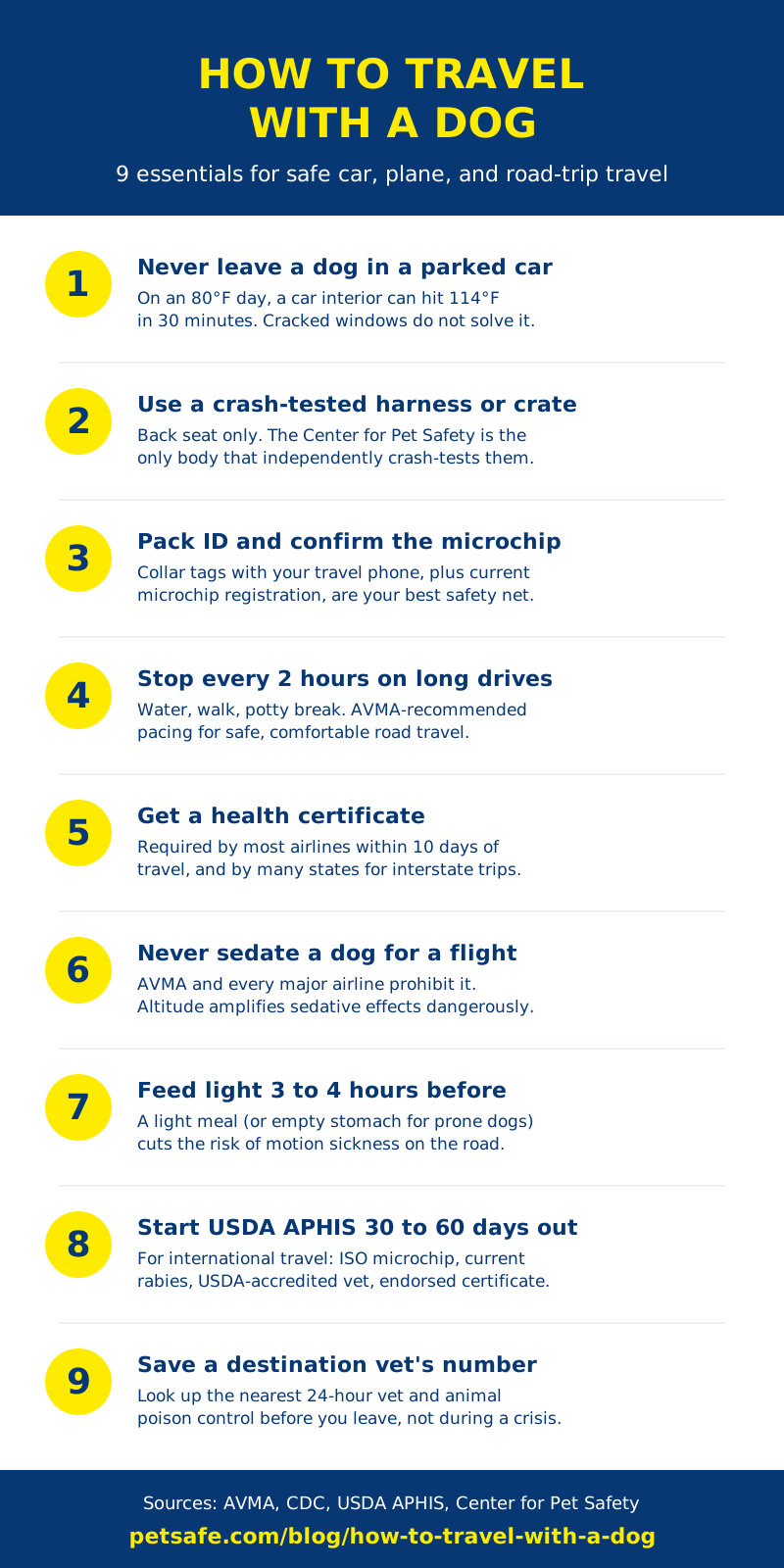
- The safest place for a dog in a moving vehicle is the back seat, secured with a crash-tested harness or in a crash-tested crate. The American Veterinary Medical Association warns that unrestrained dogs can be seriously injured by deploying airbags and can become dangerous projectiles in a collision. [1][2]
- Never leave a dog alone in a parked car. The AVMA reports that on an 80°F day, the temperature inside a vehicle can rise to 114°F in 30 minutes, and hundreds of pets die every year from heat exhaustion after being left in parked vehicles. [1][3]
- Sedatives and tranquilizers are not safe for air travel. The AVMA and every major U.S. airline warn that sedating a dog before a flight increases the risk of respiratory and cardiovascular problems at altitude. Give calming medication only under direct veterinary guidance for ground travel. [4][5]
- International travel with a dog requires a USDA-accredited veterinarian, an APHIS-endorsed health certificate issued within days of departure, and destination-specific rabies, microchip, and quarantine rules. Start the process at least 30 to 60 days before travel, and longer for rabies-controlled countries. [6][7]
- The Center for Pet Safety is the only independent organization that crash-tests pet harnesses, carriers, and crates to a published protocol adapted from the federal child-restraint standard (FMVSS 213). Only a handful of products have earned CPS certification. [8]
Traveling with a dog is one of the great joys of pet parenthood. Most dogs love the ride, love the sights, and love the fact that they get to stay with their person the whole way. But a car, an airline cabin, or a border crossing is a very different environment than a familiar living room, and the safety stakes are real: unrestrained dogs cause driver distraction, get thrown in crashes, and can face life-threatening complications when travel is not planned carefully.
This guide walks you through how to travel with a dog the safe way, whether you are running a quick errand across town, driving cross-country, boarding a domestic flight, or taking your pup overseas. Every recommendation below is grounded in current guidance from the American Veterinary Medical Association, the Centers for Disease Control and Prevention, the USDA Animal and Plant Health Inspection Service, and independent crash-testing from the Center for Pet Safety.
If you are also traveling with a cat, or planning a multi-pet trip, see our companion guides on how to travel with a cat and pet travel safety tips for a species-agnostic overview.
Table of Contents
- Before You Go: Is the Trip Right for Your Dog?
- How To Travel With a Dog in a Car
- Long Road Trips: Planning, Pit Stops, and Overnight Stays
- Motion Sickness and Car Anxiety
- How To Travel With a Dog on a Plane
- International Travel With a Dog
- The Complete Dog Travel Packing List
- Emergency Prep and What To Do if Your Dog Gets Lost
- Frequently Asked Questions
- Citations and sources
Before You Go: Is the Trip Right for Your Dog?
The single most important travel decision happens before you leave the driveway. Not every trip is right for every dog. A young, healthy Labrador who has already ridden in the car dozens of times is a different traveler than a senior dog with arthritis, a puppy who has never left the yard, or a flat-faced breed with breathing challenges.
Ask yourself three questions before committing:
- Is my dog physically ready? Talk to your veterinarian about your dog's age, health, joint mobility, and any conditions that could be aggravated by long hours in a crate or car seat. Brachycephalic (flat-faced) breeds like French Bulldogs, Pugs, Bulldogs, and Boston Terriers face compounded risk during air travel because their shortened airways restrict airflow. Many airlines refuse to fly them in cargo at all. [4]
- Is my destination dog-friendly? Verify that your hotel, rental, campsite, or family member's home will actually welcome your dog. Not every "pet-friendly" listing means every dog. Check size limits, breed restrictions, and whether the destination has safe outdoor space.
- Is the trip actually better with my dog along? Some trips are more fun for both of you when your dog stays home with a trusted sitter. If your itinerary involves long stretches in venues that do not allow dogs, high heat, or crowded events where a dog would be stressed, leaving them at home is not a failure. It is a responsible choice.
"Federal regulations require that dogs and cats be at least 8 weeks old and weaned at least five days before flying. Talk to your veterinarian about whether and when to feed your pet prior to, during, and after air travel. Consult your veterinarian before giving your pet any tranquilizers or sedatives. These can increase the risk of heart or respiratory problems and generally are not allowed by airlines." [1]
American Veterinary Medical Association, Traveling With Your Dog or Cat
Once you have committed to bringing your dog, book a pre-travel veterinary visit. Confirm vaccinations are current, request any records you may need at your destination, and ask about motion-sickness medication if your dog has struggled with car rides in the past. For dogs traveling by air or across state lines, ask about a Certificate of Veterinary Inspection (CVI), often called a health certificate. Most airlines require one issued within 10 days of travel, and many states require one for interstate transport. [1][9]
How To Travel With a Dog in a Car
Car travel is where most dogs spend most of their travel time, and it is where the safety data is the most alarming. In a 30 mph collision, an unrestrained 50-pound dog can exert up to 1,500 pounds of force on impact, injuring the dog, the driver, and any passengers in the way. [8] The AVMA's official position is unambiguous: it is unsafe for pets to be loose inside motor vehicles. [2]
The Back Seat, Every Time
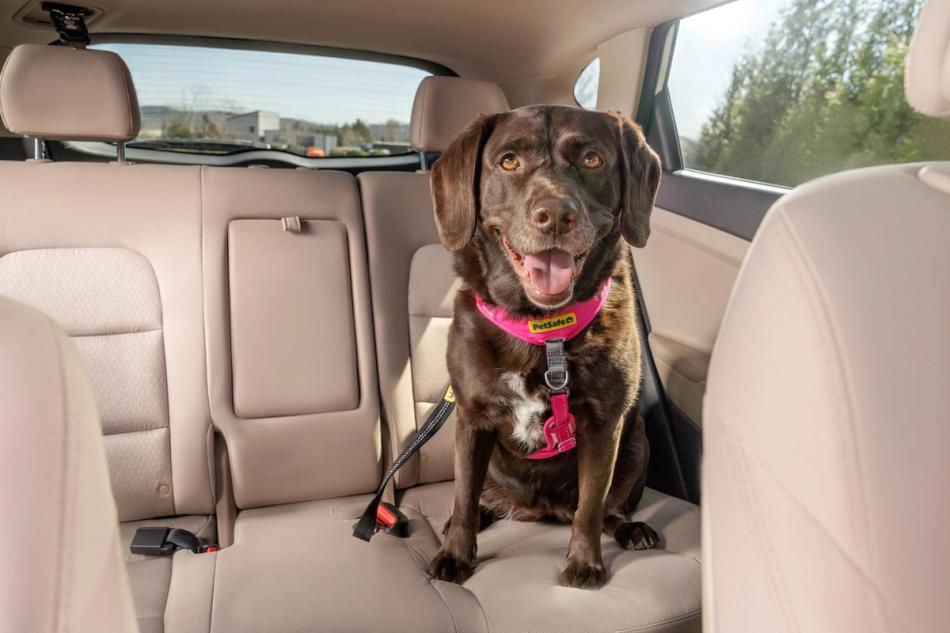
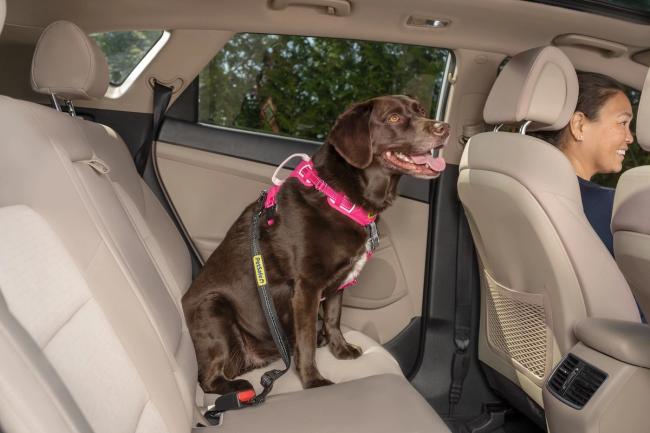
The safest place for a dog in a moving vehicle is the back seat, properly restrained. The reasoning is the same as for a small child: airbags are designed to protect adult humans in a collision, and the way they deploy can seriously injure or kill a dog in the front seat, even one wearing a harness. Front-seat dogs are also a top source of driver distraction. [1][10]
Never place a dog in an open truck bed. Unsecured dogs can jump or fall out at highway speeds, and dogs tied down with leashes can become dangerously entangled before the driver can react. The AVMA explicitly warns against this practice. [2]
Crash-Tested Restraints Matter
The phrase "crash-tested" is not regulated. Any company can strap a harness to a sled, film the test in their warehouse, and call it crash-tested. What actually matters is whether the product has been independently tested to a published standard with pass or fail criteria. [8]
The Center for Pet Safety (CPS) is a non-profit that independently crash-tests pet restraints using a protocol adapted from Federal Motor Vehicle Safety Standard 213, the same standard used for child safety seats. They use instrumented dog test dummies, run dynamic 30 mph crash tests, and publish the results. Only a small number of products across all categories have earned CPS certification. [8]
When shopping for a car restraint, look for one of these three configurations:
- Crash-tested harness with seatbelt tether. The harness wraps around the dog's chest and shoulders (the strongest part of the body) and connects to the vehicle's seatbelt or a tether anchored to the seatbelt. Look for CPS certification or independent testing to FMVSS 213 or ECE R-17 standards.
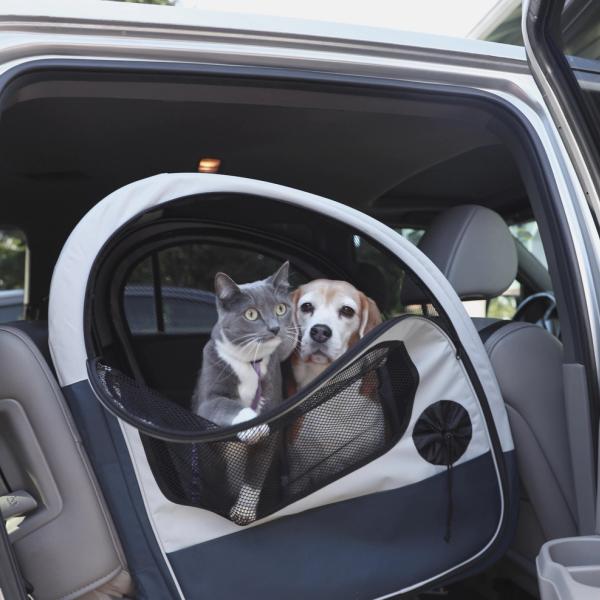
- Crash-tested travel crate anchored to the vehicle. A rigid crate secured with the seatbelt or LATCH anchors keeps a small to medium dog contained and gives them a familiar den on the road.
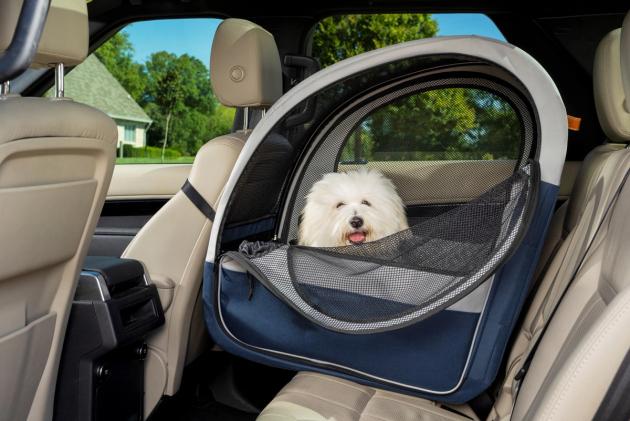
- Crash-tested safety seat for small dogs. For dogs under about 30 pounds, a car safety seat that anchors to the vehicle and clips onto the dog's harness works like a child car seat, keeping small dogs elevated and contained.
Whichever restraint you choose, take the time to fit it properly. A harness that is too loose will not restrain the dog in a crash, and one that is too tight will not get used because the dog will resist it. Adjust straps so you can fit two fingers between the harness and your dog's body.
Never Leave a Dog in a Parked Car
This is the rule that has to survive every travel plan, every errand, every "I'll only be five minutes." According to the AVMA, on an 80°F day, the interior of a vehicle can climb to 114°F in 30 minutes, and hundreds of pets die every year from heat exhaustion in parked cars. [1][3] Cracking the windows does not solve the problem. Parking in the shade does not solve the problem. Leaving the air conditioning running unattended risks the engine cutting out. The only safe option is to not leave a dog in a parked car at all.
If you spot a dog in distress in a parked car, call local animal control or the police. Signs of heat stroke include heavy panting, drooling, red gums, wobbliness, and vomiting. For more on recognizing and preventing heat emergencies, see our full guide on how to spot and prevent heat stroke in dogs.
Long Road Trips: Planning, Pit Stops, and Overnight Stays
A cross-country road trip with a dog is one of the best experiences in pet parenthood. It also takes real planning. The AVMA recommends stopping every two hours on long drives to let dogs exercise, relieve themselves, and rehydrate. [1] The CDC adds that frequent stops help prevent stress-related digestive issues and reduce motion sickness. [3]
Plan the Route Around Your Dog
- Map pet-friendly stops in advance. Rest areas, dog parks, and pet-welcoming gas stations are not evenly distributed. Highway apps and pet-travel websites let you filter by dog-friendly locations before you leave.
- Time drives around meals and heat. Feed a light meal three to four hours before departure to reduce motion sickness. On hot days, drive during cooler morning and evening hours and avoid pavement walks when the ground is hot enough to burn paw pads (as a general rule, if you cannot hold the back of your hand on the pavement for seven seconds, it is too hot for your dog).
- Book pet-friendly lodging ahead. Most major chains accept dogs, but pet fees, size limits, and breed restrictions vary. Call to confirm the dog policy on the specific property, not just the brand. Some rentals require dogs to be crated when you leave the room.
Pit-Stop Routine
At every stop, follow the same routine so your dog knows what to expect:
- Leash your dog before opening the vehicle door. Dogs can bolt at rest stops in unfamiliar territory.
- Walk for 5 to 10 minutes to let them stretch and relieve themselves.
- Offer water in a collapsible or spill-proof bowl.
- Skip large meals during the drive. Small snacks are fine.
- Check paw pads for cracks or hot-surface damage before loading back up.
Making Overnight Stops Feel Like Home
Dogs settle faster in a new space if the space smells and feels familiar. Bring the same bed, blanket, and one or two favorite toys. Feed on the same schedule. If your dog is anxious in a new environment, an interactive puzzle toy can help focus their attention on something familiar while they adjust.
Water is often the first thing an anxious traveling dog will refuse in a new place. Bringing a bit of water from home, or using bottled water for the first day, can help. For more on keeping a dog hydrated during travel, see how to keep your pet hydrated.
Motion Sickness and Car Anxiety
Motion sickness is a real and common problem, especially in puppies. Industry research has estimated that millions of dogs experience motion sickness, and only about a quarter receive veterinary treatment for it. [11] The mechanism is the same as it is in humans: the inner ear's balance apparatus is not fully developed in young dogs, and conflicting signals between the eyes and the vestibular system trigger nausea. Many puppies outgrow it by about one year old. [12][13]
Signs Your Dog Is Motion Sick
Watch for these signals during or after a car ride:
- Excessive drooling or lip licking
- Whining or restlessness
- Panting when the car is not hot
- Yawning repeatedly (a stress sign, not tiredness)
- Vomiting or diarrhea
- Refusing to enter the car in the future
Prevention Strategies
Most dogs improve with a combination of these approaches:
- Desensitization. Start with the car parked and turned off. Sit inside with your dog, offer treats, and leave. Repeat over several days, then try starting the engine, then a short trip to a fun destination like a park. Build tolerance gradually. If your dog stops eating or shows anxiety, back up a step.
- Empty stomach. Do not feed a full meal within three to four hours of travel. Some dogs do better with an entirely empty stomach for four to six hours before a ride.
- Fresh air and cool temperature. Crack windows or run the air conditioning. A hot, stuffy interior worsens nausea.
- Facing forward. Dogs sitting sideways or backward are more prone to motion sickness. A properly fitted harness or a crate positioned so the dog faces forward can reduce symptoms.
- Anti-nausea medication. Prescription maropitant citrate (Cerenia) was developed specifically for motion sickness in dogs. It does not cause drowsiness and is given about two hours before travel. Only your veterinarian can prescribe it. Over-the-counter human motion sickness medications should never be given without veterinary guidance because dosing is not straightforward and some cause significant drowsiness. [12][13]
If your dog does vomit or have an accident in the car, do not scold them. Punishment reinforces the negative association and makes the next trip worse. Clean up calmly, take a break, and get back on the road when your dog is settled.
How To Travel With a Dog on a Plane
Flying with a dog is a bigger commitment than driving. Airlines have their own rules, breed restrictions, temperature embargoes, and carrier requirements, and they change often. Book your dog's ticket the same day you book yours. Airlines cap the number of pets per flight, and some routes fill up months in advance.
In-Cabin vs. Cargo
There are two ways a dog can fly:
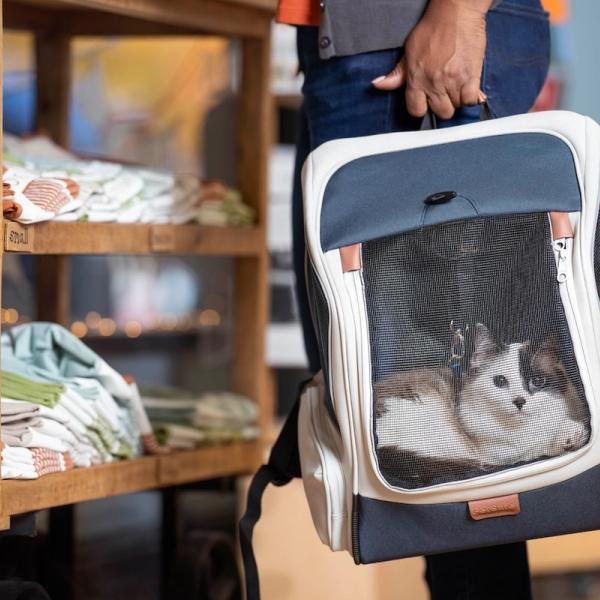
- In-cabin. Only small dogs qualify. Every major U.S. airline limits in-cabin pets to what fits inside an approved soft-sided carrier under the seat in front of the passenger. The general ceiling is around 20 pounds, including the carrier, but exact limits and carrier dimensions vary by airline. The dog must remain in the carrier for the entire flight, including boarding and taxi.
- Cargo (as checked baggage or manifest cargo). Larger dogs must fly in the pressurized, climate-controlled cargo hold. Some airlines have suspended cargo pet transport entirely, others accept only certain routes or seasons, and several restrict brachycephalic breeds. Book direct flights when possible to reduce transfer risk. [3]
American Airlines follows the AVMA's guidance and does not accept pets that have been sedated or tranquilized. Sedated pets are at a higher risk of respiratory and cardiovascular problems at high altitudes. [5] Delta, United, and every other major U.S. carrier follow the same rule. If an airline handler sees a dog with glassy eyes, uncoordinated gait, or unresponsive behavior at check-in, the dog will be denied boarding.
Sedation: The AVMA Position
The AVMA is direct on this point: sedatives and tranquilizers should not be given to pets transported by air unless a veterinarian determines it is medically necessary. Even a vet-prescribed sedative given at home before the flight can have exaggerated effects at altitude. Reduced oxygen, cabin pressure changes, and stress amplify the effects unpredictably and sometimes dangerously. [4] For flat-faced breeds, the risk is compounded because sedation relaxes the airway muscles that are already restricted in these breeds.
If your dog has severe travel anxiety, talk to your veterinarian about non-sedating alternatives: pheromone sprays, calming supplements, crate acclimation weeks before the trip, or in some cases, an honest conversation about whether the flight is the right choice at all. Ground transport, a professional pet transport service, or leaving the dog with a trusted sitter may be safer options.
Carrier Requirements
Airlines are strict about carrier dimensions. Non-compliant carriers get rejected at check-in, and the dog does not fly. Before you book, download the specific carrier requirements from your airline's website. Key requirements for in-cabin carriers:
- Must fit under the seat in front of you. Typical maximum dimensions are around 18 to 19 inches long, 11 inches wide, and 11 inches tall, but this varies.
- Ventilation on at least two sides.
- Waterproof bottom, secure zipper, and a leash-proof top opening.
- Your dog must be able to stand up, turn around, and lie down comfortably inside.
For cargo travel, carriers must meet International Air Transport Association (IATA) Live Animals Regulations. That means a rigid, ventilated crate with a solid floor, secure metal hardware (no plastic clips), food and water dishes accessible from outside, and clear labeling. Acclimate your dog to the crate at least a month before travel. A crate that arrives at the airport as a stranger is a crate the dog will fight.
Airport Day Checklist
- Arrive 90 minutes to two hours earlier than the airline recommends. Pet check-in is at a physical counter, not the kiosk.
- Withhold food for four hours before boarding. Offer small amounts of water up until check-in.
- Attach ID tags to the collar and to the carrier itself. Write your name, phone number, destination address, and destination phone on the carrier.
- Bring a printed copy of the health certificate and any airline paperwork. Do not rely on your phone.
- Walk your dog immediately before check-in. Many airports have designated pet relief areas, and the TSA and airline staff can direct you.
International Travel With a Dog
International pet travel is the single most complicated part of dog travel, and the rules change frequently. Every country sets its own entry requirements, and the U.S. has its own re-entry rules on the way back. The single most important thing you can do is start the process at least 30 to 60 days before travel, and much longer for rabies-controlled countries where an antibody titer test with a mandatory waiting period is required. [6][7]
Who Handles What
Three U.S. agencies are involved, and they do different things:
- USDA APHIS (Animal and Plant Health Inspection Service). Endorses the international health certificate that most countries require for entry. APHIS does not decide whether your dog can enter another country. It endorses the paperwork the destination country requires. [6]
- CDC (Centers for Disease Control and Prevention). Sets the rules for dogs entering or returning to the United States, including rabies vaccination requirements based on where the dog has traveled. [7]
- Destination country. Sets its own entry rules. The USDA APHIS Pet Travel website lists country-specific requirements, but you should also verify with the destination country's embassy because rules change.
The Standard International Checklist
- ISO-compliant microchip. Most countries require an ISO 11784 and 11785 compliant microchip (15 digits). U.S. microchips are often not ISO compliant. If yours is not, your veterinarian can implant an ISO chip before the rabies vaccination, because the chip must be in place before the vaccine to establish the animal's identity for the rabies record. [14]
- Current rabies vaccination. Must be administered after the microchip and typically within a set window before travel (rules vary by country). For rabies-controlled countries like Australia, New Zealand, Japan, Hawaii, and much of the EU coming from certain regions, a follow-up rabies antibody titer test may be required, and there is often a mandatory waiting period after the titer before entry is allowed.
- USDA-accredited veterinarian. Only a USDA-accredited veterinarian, not just any state-licensed vet, can issue the international health certificate. Confirm your vet's accreditation status when you book the pre-travel visit.
- Health certificate endorsement. Most international health certificates must be endorsed by a USDA APHIS official through the Veterinary Export Health Certification System (VEHCS). Standard processing is 2 to 5 business days, but seasonal backlogs can extend that. Certificates are typically valid for only 10 days before travel, which is why the timing is so tight. [6][15]
- Country-specific paperwork. Some countries require additional treatments (tapeworm treatment for the EU, screwworm certification for certain regions), quarantine, or advance import permits. Check the USDA APHIS Pet Travel page for your destination country. [6]
Returning to the United States
The CDC sets the rules for dogs returning to the U.S., and the requirements depend on where the dog has been in the six months before arrival:
- From low-risk or rabies-free countries. A completed CDC Dog Import Form receipt and standard baseline health documentation.
- From high-risk countries for dog rabies. Additional requirements apply, including a Certification of U.S.-Issued Rabies Vaccination form completed by a USDA-accredited veterinarian before the dog left the U.S. This form cannot be issued retroactively. If you skip this step on the way out, your dog may face extended re-entry hurdles. [7]
Before you book a non-refundable international flight, verify current requirements at aphis.usda.gov/pet-travel and the CDC's bringing an animal into the United States page. The rules published today may be different from the rules published six months ago.
The Complete Dog Travel Packing List
Print this list, tape it to your fridge, and check it the night before you leave.
Identification and documents
- Collar with current ID tags (home address, phone, and destination phone)
- Microchip confirmed and registration current
- Recent photo of your dog on your phone (in case they get lost)
- Rabies certificate and vaccination records
- Health certificate if traveling interstate or internationally
- Copy of pet insurance information, if applicable
Food and water
- Regular dog food (bring extra in case of delays)
- Sealed water from home for the first day at your destination
- Food and water bowls (collapsible bowls work well)
- Any prescription supplements or medications
Safety and restraint
- Crash-tested harness with seatbelt tether, or a crash-tested travel crate
- Leash and a spare leash
- Waterproof seat cover to protect the vehicle interior
Comfort
- Bed or blanket from home
- One or two familiar toys
- Chew for long stretches in the car or crate
Health and cleanup
- Poop bags (more than you think you need)
- Paper towels and enzyme cleaner for accidents
- First aid kit (gauze, styptic powder, saline for eye rinse, tweezers, thermometer)
- Motion sickness medication if prescribed
- Tick and flea preventive current
Emergency Prep and What To Do if Your Dog Gets Lost
Even the most careful travelers face emergencies. Rest stop bolt-outs, off-leash mishaps in unfamiliar territory, and sudden illness at a hotel are the three most common travel emergencies. Preparation makes them survivable.
Before You Leave
- Save the phone number and address of a 24-hour emergency veterinary clinic near your destination. The nearest ASPCA Poison Control number (888-426-4435) and ASPCA Animal Poison Control fee are worth having noted as well.
- Confirm your dog's microchip registration is current, with your correct phone number attached.
- Take a clear, recent photo showing any distinguishing markings.
If Your Dog Gets Lost
- Search the immediate area first. Most dogs stay within a mile of where they were last seen for the first 24 hours. Search on foot, calling calmly, without a group of strangers, which can scare a dog into hiding.
- Contact local animal control, shelters, and vet clinics. File a lost report and leave your travel phone number. Ask them to scan any incoming dogs for microchips.
- Post on local social media and lost-pet networks. Nextdoor, local Facebook groups, and services like Pawboost reach large audiences fast.
- Return to the last-seen location repeatedly. Bring familiar-smelling items (their bed, a piece of your clothing). Scared dogs often return to where they last saw their person.
Frequently Asked Questions
What is the safest way for a dog to travel in a car?
The safest way for a dog to travel in a car is in the back seat, secured with a crash-tested harness attached to the vehicle's seatbelt or in a crash-tested travel crate anchored to the seat. The Center for Pet Safety is the only independent organization that crash-tests pet restraints to the same federal standard used for child safety seats. Front-seat travel is not safe because deploying airbags can seriously injure dogs. [2][8]
How often should I stop when driving long distances with a dog?
The AVMA recommends stopping every two hours on long drives to let your dog walk, drink water, and relieve themselves. On hot days, stop more frequently and check that pavement is not too hot for paw pads. For dogs prone to motion sickness or anxiety, shorter and more frequent stops can help. [1]
Can I sedate my dog for a flight?
No. The AVMA and every major U.S. airline specifically prohibit sedating dogs for air travel unless a veterinarian determines it is medically necessary. Sedation at altitude increases the risk of respiratory and cardiovascular problems, and flat-faced breeds face compounded risk. Airlines will deny boarding to dogs that appear sedated at check-in. Talk to your veterinarian about non-sedating alternatives if your dog has travel anxiety. [4][5]
How much does it cost to travel with a dog?
Costs vary widely. Airline pet fees typically range from $95 to $200 each way for in-cabin travel on major U.S. carriers. Cargo travel costs more, often several hundred dollars, plus IATA-compliant crate costs. Hotel pet fees run $25 to $150 per stay. International travel adds veterinary visit costs, USDA APHIS endorsement fees, potential titer testing (typically $80 to $300), and sometimes shipping costs for endorsed certificates.
How do I travel internationally with a dog?
Start at least 30 to 60 days before travel, and longer for rabies-controlled countries. Confirm your veterinarian is USDA-accredited. Ensure your dog has an ISO-compliant microchip and current rabies vaccination. Check destination country requirements on the USDA APHIS Pet Travel website. Book your veterinary appointment, obtain the international health certificate, submit it to USDA APHIS through the VEHCS system for endorsement (2 to 5 business days processing), and travel within the 10-day validity window. Confirm CDC requirements for returning to the U.S. before you leave. [6][7]
Is it safe to travel with a puppy?
Federal regulations require dogs to be at least 8 weeks old and weaned for at least five days before flying. For car travel, puppies can start with short local trips as soon as they are cleared by their veterinarian, but keep trips short and frequent for the first several months. Puppies are more prone to motion sickness than adult dogs because their inner ear balance apparatus is not fully developed. Many puppies outgrow motion sickness by about one year old. [1][12]
Do I need a health certificate to travel with my dog?
For air travel, most airlines require a health certificate (Certificate of Veterinary Inspection or CVI) issued within 10 days of travel. Many states require one for interstate transport, though enforcement is inconsistent. International travel always requires a USDA APHIS-endorsed health certificate specific to the destination country. Check your airline and destination requirements when you book. [1][6]
Citations and sources
- American Veterinary Medical Association. "Traveling with Your Dog or Cat." avma.org
- American Veterinary Medical Association. "Safe non-commercial transport of pets in motor vehicles." avma.org
- Centers for Disease Control and Prevention. "Pet Travel Safety." Healthy Pets, Healthy People. cdc.gov
- American Veterinary Medical Association. "Traveling with Your Animal." avma.org
- American Airlines. "Pets Travel Information." aa.com
- USDA Animal and Plant Health Inspection Service. "Pet Travel." aphis.usda.gov
- Centers for Disease Control and Prevention. "Bringing a Dog into the United States." cdc.gov
- Center for Pet Safety. "Pet Travel Safety Research and CPS Certification." centerforpetsafety.org
- U.S. Food and Drug Administration. "Travel Training for You and Your Pets." fda.gov
- American Kennel Club. "Teach Your Dog to Ride in the Car: Preventing Anxiety and Motion Sickness." akc.org
- Preventive Vet. "Preventing and Treating Motion Sickness in Dogs." preventivevet.com
- VCA Animal Hospitals. "Motion Sickness in Dogs." vcahospitals.com
- American Kennel Club. "Car Sickness in Dogs: Signs, Symptoms, Treatments." akc.org
- U.S. Department of State. "Pets and International Travel." state.gov
- USDA Animal and Plant Health Inspection Service. "Pet Travel Process Overview." aphis.usda.gov
Author
Written by PetSafe® Guest
PetSafe® Guest contributors are pet experts, trainers, veterinarians, and brand partners who share their knowledge with the PetSafe® community. Articles published under this byline are reviewed by the PetSafe® editorial team before publication.
Last Modified: July 27, 2026


Get Email Updates
Subscribe to the latest news, promotions, & more from PetSafe® brand.
Sign up today for the latest news, promotions, and more from PetSafe® brand.