July 27, 2026
PetSafe® Expert
PetSafe® Guest
How To Travel With a Cat: Car, Plane and Long-Distance Tips
Key Points
- Most cats prefer to stay home. Cats are territorial, and travel disrupts the scent-marked environment they rely on for a sense of safety. If your cat can stay home with a trusted sitter, that is often the safer option. [1]
- Carrier training is the single most important thing you can do before travel. Over 75% of cat caregivers report they have never received travel advice from their veterinarian, and the number one reason cats miss vet visits is difficulty getting them into a carrier. [2]
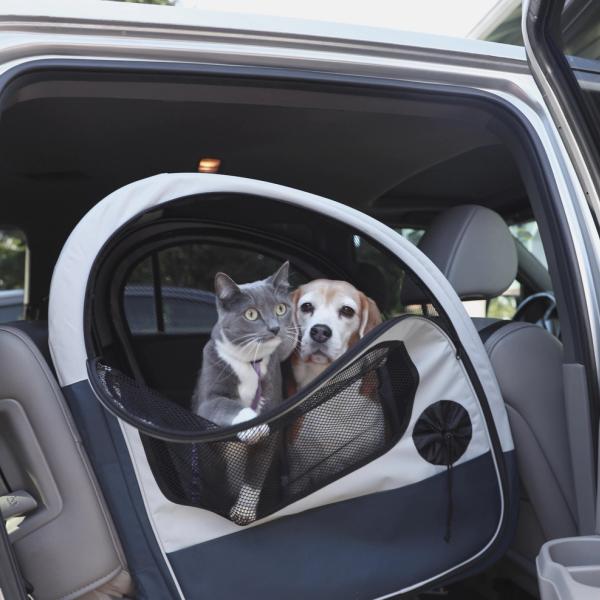
- Cats should always be in a secured carrier when traveling in a car. The carrier should be strapped to a seat with the seatbelt or wedged on the floor behind the front seat so it cannot slide or tip. Never let a cat ride loose. [3]
- The AVMA and every major U.S. airline warn against sedating cats for air travel. Sedatives increase the risk of respiratory and cardiovascular problems at altitude. Flat-faced breeds like Persians and Himalayans face compounded risk. [4][5]
- For long car trips, a travel litter box, spill-proof water, and pit stops every 2 to 3 hours make the difference between a stressed cat and a cat that arrives ready to explore. Cats descended from desert ancestors and often stop eating and drinking under stress, so hydration during the trip matters as much as at the destination. [6]
Traveling with a cat is different from traveling with almost any other pet. Dogs, for the most part, want to come along. Cats mostly want to stay home. That is not a failure of temperament, it is biology. Cats are territorial animals whose sense of safety is tied to a familiar, scent-marked environment. When you take that away, even briefly, a cat's stress response fires hard.
The good news is that traveling with a cat is very doable when you prepare. Millions of cats move across the country with their families every year, fly across oceans, and settle into new destinations without incident. The difference between a smooth trip and a stressful one comes down to three things: carrier training, a plan for the road, and knowing when travel is not the right choice at all.
This guide walks through how to travel with a cat by car, plane, or across international borders, grounded in current guidance from the American Association of Feline Practitioners, the International Society of Feline Medicine, VCA Animal Hospitals, the American Veterinary Medical Association, and the USDA Animal and Plant Health Inspection Service.
If you are traveling with a dog too, or planning a multi-pet trip, see our companion guides on how to travel with a dog and pet travel safety tips for a species-agnostic overview.
Table of Contents
- Should Your Cat Come With You?
- Carrier Training: The Two Weeks Before Travel
- How To Travel With a Cat in a Car
- Long-Distance and Cross-Country Car Trips
- Motion Sickness and Travel Anxiety
- How To Travel With a Cat on a Plane
- International Travel With a Cat
- The Complete Cat Travel Packing List
- Settling In At Your Destination
- Frequently Asked Questions
- Citations and sources
Should Your Cat Come With You?
The first travel decision is whether to travel with your cat at all. Cats are creatures of routine and territory. A cat that leaves their home for the first time in years is not being introduced to an adventure. They are being separated from every scent, sound, and hiding spot they have used to build a sense of safety.
Ask yourself three questions:
- Is my cat physically ready? Talk to your veterinarian about age, health, and any conditions that could be aggravated by travel. Cats with kidney disease, heart conditions, or advanced age often do worse with the stress of a long trip. Flat-faced (brachycephalic) breeds like Persians, Himalayans, and Exotics face additional respiratory risk during air travel because their shortened airways restrict airflow. [4]
- Is my destination cat-friendly? Verify that your hotel, rental, or family's home is safe for a cat. Ask about screens on windows, escape routes, existing pets, houseplants that are toxic to cats (lilies, tulips, sago palm), and quiet spaces where a cat can hide.
- Is a trusted sitter available? For many cats, the safest option is staying home with an in-home sitter who visits daily, feeds on schedule, and cleans the litter box. A cat sitter in the cat's own environment usually generates less stress than any trip. Boarding facilities are generally a distant second choice for cats, since they add unfamiliar smells, sounds, and other animals on top of the removal from home.
If your cat is generally healthy, you have a cat-safe destination, and either your trip is long enough that home boarding is not viable or your cat travels well, then travel makes sense. If any of those pieces is missing, the honest answer may be to leave your cat at home. That is not a failure. It is a choice that prioritizes what your cat actually needs.
"Difficulty getting the cat into a carrier at home, driving to the clinic, and dealing with the fearful cat at the veterinary clinic are the most common reasons for fewer visits. Educating and preparing the client and the veterinary team with regard to respectful feline handling is necessary in order to avoid stress." [2]
American Association of Feline Practitioners and International Society of Feline Medicine, Feline-Friendly Handling Guidelines
Carrier Training: The Two Weeks Before Travel
The single biggest predictor of a smooth trip is whether your cat is comfortable in their carrier before the trip begins. Over 75% of cat caregivers say they have never received travel advice from their veterinarian, and the number one reason cats miss annual checkups is that their humans cannot get them into a carrier without a fight. [2] Two weeks of carrier training changes that.
Choose the Right Carrier
The AAFP/ISFM Feline Friendly Guidelines and VCA both recommend hard-sided carriers for most travel scenarios. Look for:
- Hard-sided construction with a top-loading option. Cats resist being pushed head-first through a small door, but they will often step in through a top opening or allow you to gently lower them in. A carrier where the top can also be removed (so the cat can be examined without being pulled out) is ideal, especially for vet visits.
- Enough room to stand, turn around, and lie down. Not much more than that. A carrier that is too large lets a cat slide around during a car ride, which increases motion sickness.
- Ventilation on multiple sides, a secure latch, and a solid, easy-to-clean floor.
- Airline compliance if you plan to fly. In-cabin carriers must fit under the airline seat, typically around 18 inches long, 11 inches wide, and 11 inches tall, but exact dimensions vary by airline.
Turn the Carrier Into a Piece of Furniture
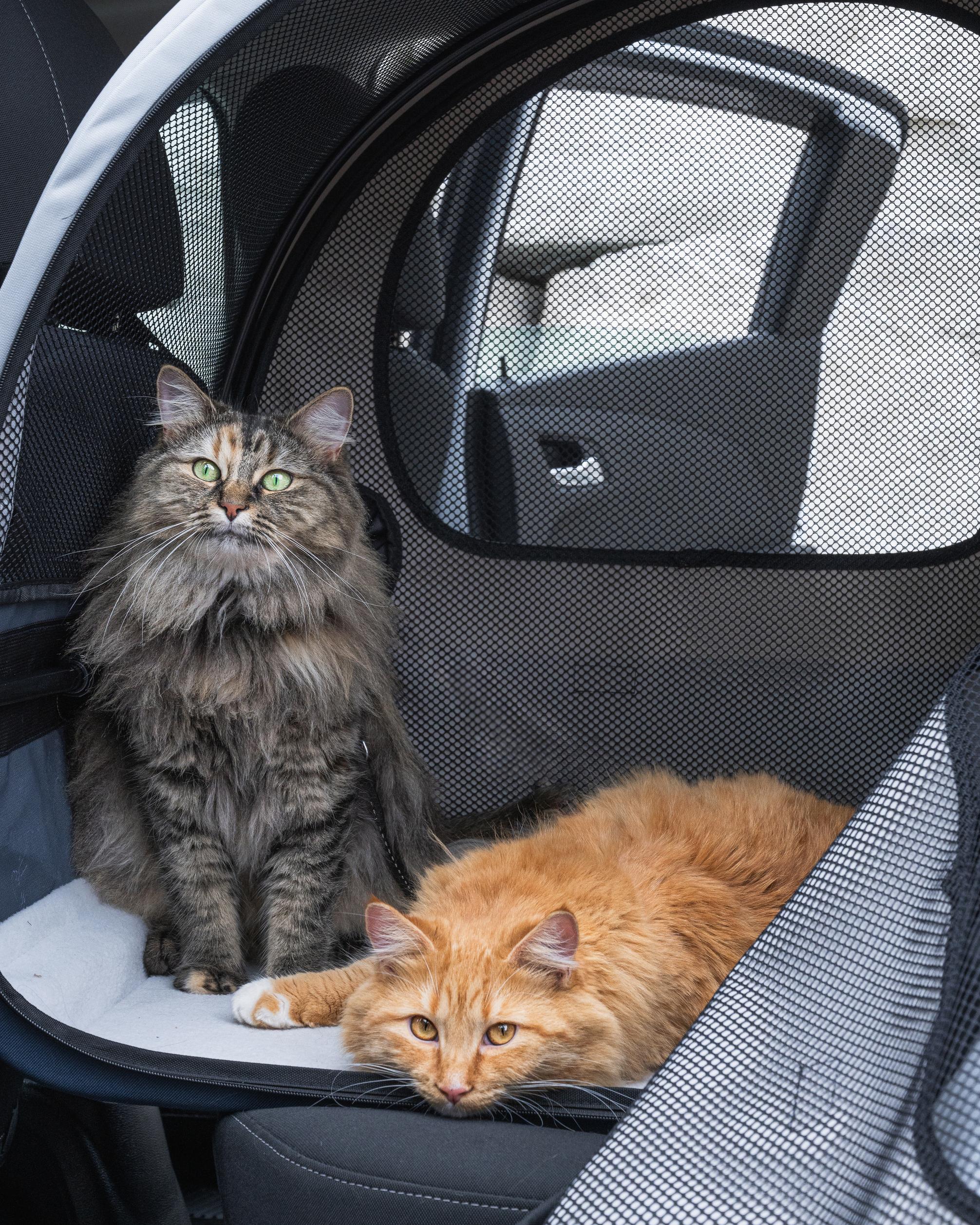
Cats respond to carriers based on what those carriers have meant in the past. If the carrier only comes out once a year, and it always means a car ride to the vet, your cat will associate it with dread. Reverse that association by leaving the carrier out in your home all the time.
- Set the carrier in a quiet, low-traffic spot with the door open or removed.
- Line the bottom with a soft blanket that has your scent or the cat's scent on it.
- Drop favorite treats inside every day. Feed a meal or two inside the carrier. Play with a wand toy that ends its arc inside the carrier.
- Let your cat come and go freely for at least a week or two before travel. When they choose to nap in the carrier, you have won.
Practice Short Car Rides
Once the carrier is a safe space, generalize that to the car. Follow the desensitization approach VCA recommends:
- Day 1 to 2: Place the cat in the carrier and carry them to the car. Sit in the car with the engine off for a few minutes, then bring them back inside and reward.
- Day 3 to 4: Same as above, but start the engine and let it run for a few minutes without moving.
- Day 5 to 6: Back out of the driveway and return.
- Day 7 onward: Short trips around the block, then longer loops, then a trip to a fun destination if possible. Reward calm behavior with treats and praise. [6]
If your cat panics at any stage, back up. Move slower. The cost of a rushed carrier training is a cat that fights the carrier for the rest of their life.
Use Pheromone Support
Synthetic feline facial pheromone sprays and diffusers mimic the calming chemical cats deposit when they rub their face on furniture and doorways. Multiple veterinary sources, including AAFP guidance and VCA Animal Hospitals, endorse pheromone products for reducing transit anxiety. Spray the empty carrier at least 15 minutes before your cat enters. Never spray directly on the cat or inside the carrier with the cat present. [6][7]
How To Travel With a Cat in a Car
Car travel is where most cats spend their travel time, whether that is a 20-minute drive to the vet or a two-day road trip across the country. The safety fundamentals are the same in both cases.
The Cat Belongs in the Carrier, Every Time
VCA is unambiguous on this: never travel with your cat free to move around in the car. [3] A loose cat is a driver hazard, a passenger hazard, and at serious risk of injury or escape. Cats that wedge themselves under the brake pedal, dart out through an opened door at a rest stop, or hide inside the dashboard have all made news for good reason.
Secure the carrier so it cannot slide, tip, or bounce during the drive:
- Back seat, secured with the seatbelt. Thread the seatbelt through the handle or through carrier-specific loops. The carrier should not shift when you brake hard.
- Or wedged on the floor behind the front passenger seat. A solid position on the floor keeps the carrier from sliding, and it stays out of direct sun and airbag range.
- Never in the front seat. Airbags are designed for adult humans. A carrier in the front seat can be crushed against the dashboard in a collision, and the airbag deployment force can seriously injure a cat inside.
Cover the Carrier
Most cats calm down significantly when their carrier is partially covered with a light, breathable blanket or towel. A dim, enclosed space reads as a cave, which triggers a settling response. Leave one side uncovered for ventilation and so you can check on your cat. Do not cover a carrier that is sitting in direct sun or where the vehicle heater or air conditioner is blowing directly onto it. [7]
Never Leave a Cat in a Parked Car
The same rule that applies to dogs applies to cats, and the physics are the same. On an 80°F day, the interior of a vehicle can climb to 114°F in 30 minutes, and hundreds of pets die every year from heat exhaustion after being left in parked vehicles. [4] Cracking the windows does not solve it. Parking in the shade does not solve it. If you need to stop for food, gas, or a bathroom break, one person stays with the cat with the engine and air conditioning running, or the whole family gets out together and the cat goes back into an air-conditioned indoor space.
Long-Distance and Cross-Country Car Trips
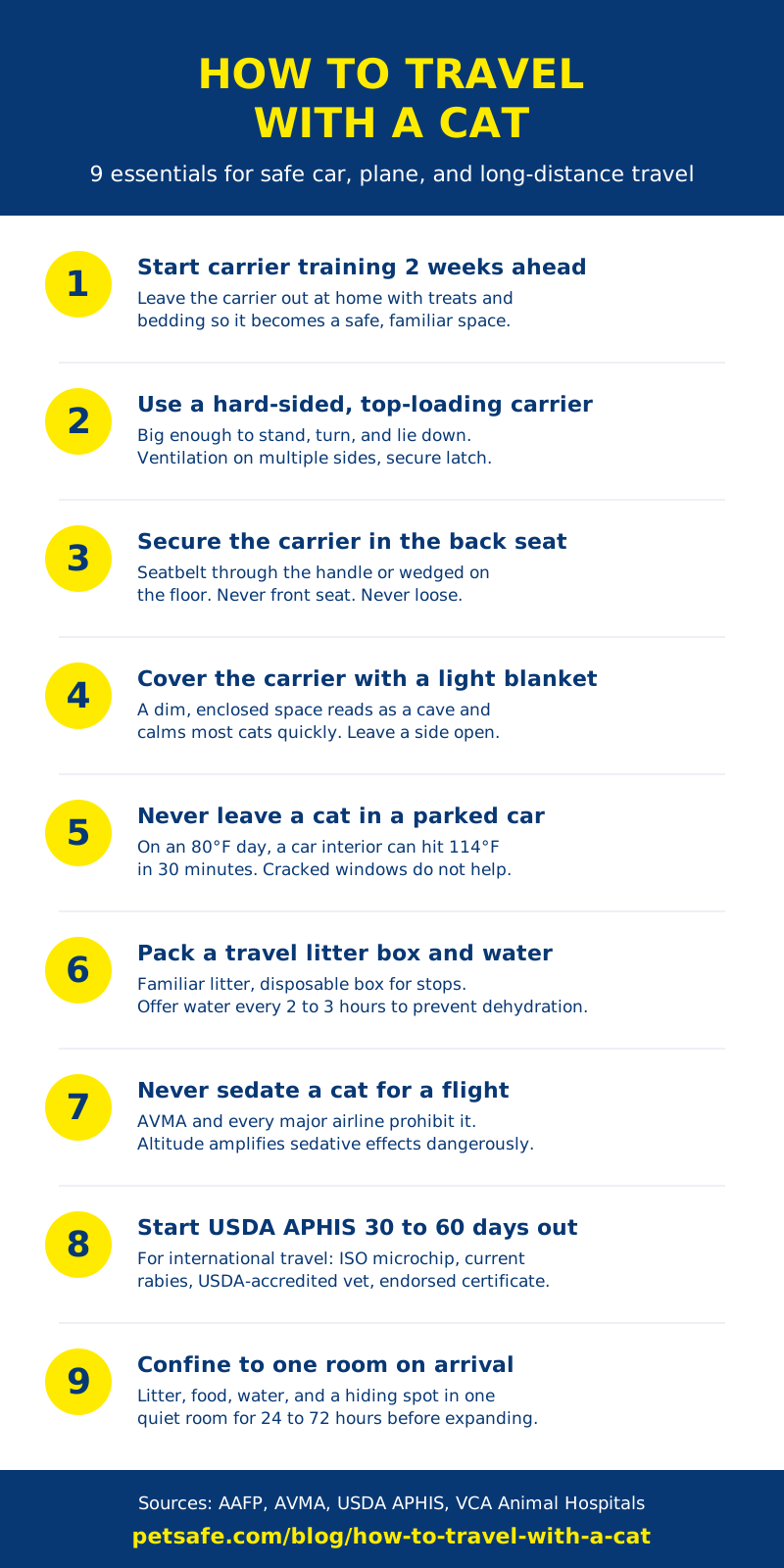
Long car trips with a cat need more planning than short ones. The cat's biggest risks on a multi-day drive are not accidents. They are dehydration, urinary retention, motion sickness, and heat exposure. Every one of these is preventable with the right routine.
Plan Around Your Cat, Not the Miles
- Pit stops every 2 to 3 hours. Unlike dogs, cats do not need a walk at every stop. Use the time to check the carrier temperature, top up water in a spill-proof bowl, and see whether your cat wants a small snack.
- Overnight stops for trips over 8 hours. Most cats do not eat, drink, or use the litter box in a moving vehicle. Booking a cat-friendly hotel for a mid-trip overnight gives your cat several hours in a controlled indoor space to reset.
- Avoid the hottest and coldest hours of the day. Drive in the morning and evening in summer. Warm up the car before loading the cat in winter.
The Travel Litter Box Question
Most cats will not use a litter box in a moving car. What they will use is a disposable, low-sided travel litter box placed in a secured location during rest stops or overnight stays. Disposable cardboard litter boxes with a small amount of familiar litter make cleanup easy and let your cat use the same setup at multiple hotel stops.
Bring litter your cat already uses. A sudden switch to a new brand or texture in the middle of a stressful trip is a recipe for litter box refusal, which often leads to accidents in the carrier or the hotel room. If your cat only uses their litter box at home, offer it at every overnight stop and let them approach it on their own schedule.
Food, Water, and the Dehydration Risk
Cats descended from desert ancestors that survive long stretches without water, and that ancient instinct can flip on during travel. A stressed cat often refuses food and water for hours or even a full day. That is manageable for a short trip but becomes dangerous on a multi-day drive, especially for cats already at risk for kidney or urinary issues.
- Offer water at every stop using a spill-proof bowl or a syringe (no needle) with a few milliliters of fresh water. Even a small amount helps.
- Bring familiar food and skip large meals during the drive. A light meal three to four hours before departure and small snacks at overnight stops work better than a full meal in the carrier.
- Bring water from home for the first day or two. Sudden changes in water source can add stomach upset on top of travel stress. For more on keeping a cat hydrated during travel and at home, see how to keep your pet hydrated.
Booking Cat-Friendly Lodging
Most major hotel chains accept cats, but rules vary widely. Confirm with the specific property before you book:
- Cat pet fee and any deposit
- Whether the cat must be crated when you are out of the room (many hotels require this)
- Whether the property has any resident pets that could stress your cat
- Whether windows have screens and doors close securely
Motion Sickness and Travel Anxiety
Cats show travel stress differently than dogs. Where a dog might whine or pace, a cat is more likely to go silent, hunker down, and mask distress. That does not mean they are handling it well. Learn to read the subtle signals.
Signs of a Stressed Cat
- Excessive drooling or lip licking
- Panting (rare in cats and always a stress signal)
- Dilated pupils and flattened ears
- Vocalizing (yowling, howling, meowing constantly)
- Vomiting or defecation in the carrier
- Trembling or crouching in the back of the carrier
- Refusing food or water for extended periods
Prevention and Support
- Carrier training first. Most travel anxiety in cats traces back to a carrier they associate with negative experiences. The two-week training routine described above prevents most of it.
- Empty stomach or light meal. VCA recommends withholding food for a few hours before travel to reduce nausea. Water access continues right up until departure. [6]
- Pheromone spray in the carrier 15 minutes before loading.
- Covered carrier and a familiar-smelling blanket inside.
- Steady driving. Sudden braking, sharp turns, and aggressive acceleration all worsen motion sickness. Drive like you have a full cup of coffee on the dashboard.
- Prescription options if needed. For cats with severe travel anxiety or motion sickness, veterinarians commonly prescribe gabapentin (given about two hours before travel) or maropitant citrate (Cerenia) for anti-nausea. These are only appropriate under direct veterinary guidance, and both should be trialed at home before a long trip so you know how your cat reacts. [7][8]
If your cat vomits or has an accident in the carrier during travel, do not scold them. Clean up calmly at the next safe stop, spot-clean the carrier with an enzymatic cleaner if you can, replace the blanket, and continue. Punishment reinforces the negative association and makes future travel worse.
How To Travel With a Cat on a Plane
Flying with a cat is more complicated than driving. Airlines have their own carrier rules, breed restrictions, and pet-per-flight limits that fill up months in advance. Book your cat's ticket the same day you book yours.
In-Cabin vs. Cargo
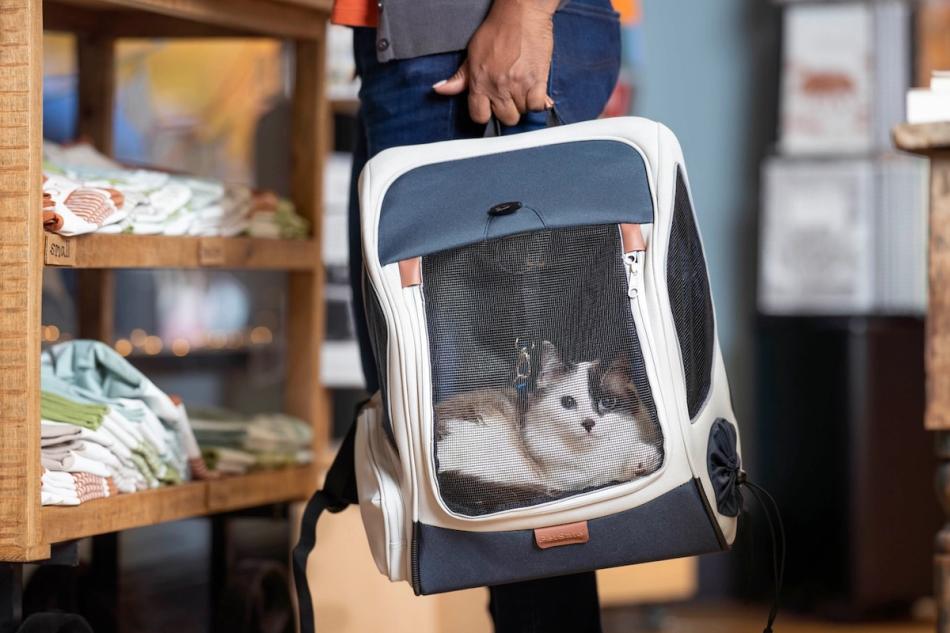
- In-cabin. Almost all pet cats fly in the cabin under the seat in front of you. Every major U.S. airline caps in-cabin pets at a soft-sided carrier that fits under the seat, typically with a combined cat-plus-carrier weight limit around 20 pounds. Your cat must remain in the carrier for the entire flight, including boarding and taxi.
- Cargo. Most cat owners avoid cargo travel, and many airlines have suspended cat cargo transport entirely. If cargo is your only option (usually for international relocations), work with a professional pet transport service and use an IATA-compliant hard-sided kennel. Flat-faced breeds should not fly cargo. [4]
Sedation: The AVMA Position
The AVMA is direct: sedatives and tranquilizers should not be given to cats transported by air unless a veterinarian determines it is medically necessary. Sedation at altitude increases the risk of respiratory and cardiovascular problems, and airlines will deny boarding to cats that appear sedated at check-in. [4][5]
If your cat has severe travel anxiety, talk to your veterinarian about non-sedating alternatives. Gabapentin, for example, reduces anxiety without heavy sedation and is often prescribed for cat travel, though even this should be trialed at home first and cleared with the airline before the flight. [8]
Carrier Requirements for Cabin Travel
- Soft-sided, ventilated on at least two sides, with a leak-proof bottom.
- Fits under the airline seat. Typical maximum dimensions are around 18 inches long, 11 inches wide, and 11 inches tall, but exact dimensions vary by airline.
- Secure top zipper. Cats can and do escape from carriers with weak zippers.
- Space for the cat to stand up, turn around, and lie down comfortably.
Airport Day Checklist
- Arrive 90 minutes to two hours earlier than the airline recommends. Pet check-in is at a physical counter, not a kiosk.
- Withhold food for four hours before boarding. Offer small amounts of water up until check-in.
- Attach ID tags to the collar and to the carrier itself with your name, phone, and destination address.
- Bring a printed copy of the health certificate. Airlines typically require one issued within 10 days of travel.
- Bring a small pheromone-sprayed blanket, a couple of familiar toys, and absorbent pads for the carrier floor.
- At security, you will need to remove your cat from the carrier and carry them through the metal detector. Practice this in advance with a harness so your cat does not bolt at the checkpoint.
International Travel With a Cat
International travel with a cat requires the same paperwork as international travel with a dog, with a few cat-specific differences. Start the process at least 30 to 60 days before travel, and much longer for rabies-controlled countries where a titer test with a mandatory waiting period is required. [9]
Who Handles What
- USDA APHIS. Endorses the international health certificate that most countries require. Only a USDA-accredited veterinarian, not any state-licensed vet, can issue the certificate for USDA endorsement. [9]
- CDC. Sets the rules for cats entering or returning to the United States, though CDC requirements for cats are generally less strict than for dogs.
- Destination country. Sets its own entry requirements. Check the USDA APHIS Pet Travel page for the specific rules for your destination.
The Standard International Checklist
- ISO-compliant microchip. Most countries require an ISO 11784 and 11785 compliant microchip (15 digits). The microchip must be implanted before the rabies vaccination to establish the animal's identity. [10]
- Current rabies vaccination. Administered after the microchip and typically within a set window before travel. For rabies-controlled countries like Australia, New Zealand, Japan, Hawaii, and much of the EU coming from certain regions, a follow-up rabies antibody titer test may be required, with a mandatory waiting period before entry.
- USDA-accredited veterinarian. Confirm accreditation when you book the pre-travel visit.
- Health certificate endorsement. Most international health certificates must be endorsed by USDA APHIS through the Veterinary Export Health Certification System (VEHCS). Standard processing is 2 to 5 business days, but seasonal backlogs can extend that. Certificates are typically valid for only 10 days before travel. [11]
- Country-specific paperwork. Some destinations require additional treatments, advance import permits, or quarantine periods for cats. Check the USDA APHIS page for your specific destination.
Before you book a non-refundable international flight, verify current requirements at aphis.usda.gov/pet-travel and the CDC's bringing an animal into the United States page. Rules change frequently.
The Complete Cat Travel Packing List
Print this list and check it the night before you leave.
Identification and documents
- Collar with a breakaway design and current ID tags (home address, phone, destination phone)
- Microchip confirmed and registration current
- Recent photo of your cat on your phone (in case they get lost)
- Rabies certificate and vaccination records
- Health certificate if traveling by air or internationally
- Copy of pet insurance information, if applicable
Carrier and restraint
- Hard-sided carrier for car travel, or airline-compliant soft-sided carrier for cabin flights
- Light blanket to partially cover the carrier
- Familiar-smelling bedding or towel for the carrier floor
- Harness and leash for airport security and controlled outings
Food and water
- Regular cat food in the exact type and brand your cat eats at home (bring extra)
- Bottled water or water from home for the first day
- Spill-proof food and water bowls (collapsible bowls work well)
- Treats your cat already likes
- Any prescription supplements or medications
Litter and cleanup
- Disposable travel litter box or a small covered litter box
- Familiar litter (bring more than you think you need)
- Scoop and sealable bags for waste
- Enzymatic cleaner and paper towels for accidents
Comfort and calming
- Pheromone spray for the carrier and destination room
- One or two familiar toys
- Bed or blanket from home to help the destination feel familiar
Health and emergency
- First aid kit (gauze, saline for eye rinse, thermometer, styptic powder)
- Prescribed anti-anxiety or motion-sickness medication if applicable
- Phone number and address of the nearest 24-hour emergency veterinary clinic at your destination
- ASPCA Animal Poison Control number (888-426-4435)
Settling In At Your Destination
Arriving at a new place is often more stressful for a cat than the travel itself. Cats need time and control to feel safe. Rushing that process can trigger extended hiding, refusal to eat, and litter box accidents.
The One-Room Rule
For the first 24 to 72 hours at any new destination, confine your cat to a single quiet room. This is not about restricting them. It is about giving them a manageable territory to scent-mark before expanding.
- Set up the room before you let the cat out of the carrier. Litter box in one corner, food and water in another, hiding spots (a cardboard box, an open carrier, a spot under the bed) in a third.
- Open the carrier door and let the cat come out on their own. Do not reach in and pull them out. Sit quietly nearby and let them explore at their pace.
- Leave the carrier open so the cat can use it as a familiar retreat.
- Check on them but do not force interaction. Some cats want to hide for hours. That is normal.
Watch for These Warning Signs
Contact a local veterinarian if your cat shows any of these signs after arrival:
- No food or water for 24 hours
- No litter box use for 24 hours (especially for male cats, who are at risk of urinary blockage)
- Continuous panting, drooling, or open-mouth breathing
- Vomiting or diarrhea that continues past the first few hours
- Extreme lethargy or unresponsiveness
Expanding Their Territory
Once your cat is eating, drinking, and using the litter box in their starter room (usually within 1 to 3 days), you can open the door and let them explore the rest of the space at their own pace. Keep the litter box, food, and water in the starter room for at least another day so they always have a known base to return to.
Frequently Asked Questions
Is it better to leave my cat home or bring them along?
For most cats, staying home with a trusted in-home sitter is less stressful than traveling. Cats are territorial and derive a sense of safety from familiar, scent-marked environments. If your trip is short and a reliable sitter is available, leaving your cat home is usually the safer choice. Bring your cat along when the trip is long enough that home boarding is not viable, your destination is safe for a cat, and your cat is generally healthy enough for travel.
How do I travel long distance with a cat in a car?
Start with two weeks of carrier training before the trip. Use a hard-sided carrier secured with the seatbelt in the back seat or wedged on the floor. Cover the carrier partially with a light blanket. Stop every 2 to 3 hours to check on your cat, offer water, and top up any spilled bedding. For trips over 8 hours, book a cat-friendly hotel for an overnight rest. Bring a disposable travel litter box, familiar litter, familiar food, and water from home. Drive smoothly, avoid the hottest hours of the day, and never leave your cat in a parked car. [3][6]
How do I travel with a cat on a plane?
Book your cat's ticket the same day you book yours because airlines cap the number of pets per flight. Confirm your airline's in-cabin carrier dimensions and pet policy. Get a veterinary health certificate issued within 10 days of travel. On the day of travel, arrive early, withhold food for four hours before boarding, and offer small amounts of water up until check-in. Your cat must stay in the carrier for the entire flight. At security, you will need to remove your cat from the carrier and carry them through the metal detector, so practice with a harness in advance.
Can I sedate my cat for travel?
No, not without direct veterinary guidance, and generally not for air travel at all. The AVMA and every major U.S. airline warn against sedating cats for flights because sedation at altitude increases the risk of respiratory and cardiovascular problems. For ground travel, veterinarians sometimes prescribe gabapentin, which reduces anxiety without heavy sedation, but even this should be trialed at home before a long trip. Airlines will deny boarding to cats that appear sedated at check-in. [4][8]
How do I travel with a cat and a litter box?
For car trips, use a disposable, low-sided travel litter box with familiar litter your cat already uses. Cats typically will not use a litter box in a moving vehicle, so offer it at rest stops, overnight hotel stays, and at your destination. For air travel, cats do not use a litter box in the carrier during the flight. Absorbent pads in the carrier floor handle any accidents.
How much does it cost to travel with a cat?
Airline pet fees typically range from $95 to $200 each way for in-cabin travel on major U.S. carriers. Hotel pet fees run $25 to $150 per stay. Cross-country car travel primarily adds the cost of pet-friendly lodging. International travel adds veterinary visit costs, USDA APHIS endorsement fees, potential titer testing ($80 to $300), and sometimes shipping costs for endorsed certificates. Budget more time than money for international trips, since the paperwork process runs on strict deadlines.
How do I travel with a cat internationally?
Start at least 30 to 60 days before travel, and longer for rabies-controlled countries. Confirm your veterinarian is USDA-accredited. Ensure your cat has an ISO-compliant microchip and current rabies vaccination. Check destination country requirements on the USDA APHIS Pet Travel website. Book your veterinary appointment, obtain the international health certificate, submit it to USDA APHIS through VEHCS for endorsement (2 to 5 business days), and travel within the 10-day validity window. Verify CDC requirements for returning to the U.S. before you leave. [9][11]
What if my cat refuses food or water during travel?
A cat refusing food and water for a few hours during travel is normal. A cat refusing food and water for 24 hours or more is not, especially for cats already at risk for kidney or urinary issues. Offer water at every stop using a spill-proof bowl or a needleless syringe. Try warming a small amount of their regular food to release the aroma. Bring familiar food and skip large meals during the drive. If your cat still refuses at your destination after 24 hours, contact a local veterinarian.
Citations and sources
- American Association of Feline Practitioners. "2022 AAFP/ISFM Cat Friendly Veterinary Interaction Guidelines: Approach and Handling Techniques." catvets.com
- Rodan, I. et al. "AAFP and ISFM Feline-Friendly Handling Guidelines." Journal of Feline Medicine and Surgery. pmc.ncbi.nlm.nih.gov
- VCA Animal Hospitals. "Reducing the Stress of Veterinary Visits for Cats." vcahospitals.com
- American Veterinary Medical Association. "Traveling with Your Animal." avma.org
- American Airlines. "Pets Travel Information." aa.com
- VCA Animal Hospitals. "Road Trips and Car Travel With Your Cat." vcahospitals.com
- VCA Animal Hospitals. "Motion Sickness in Cats." vcahospitals.com
- VCA Animal Hospitals. "Flying with Your Cat." vcahospitals.com
- USDA Animal and Plant Health Inspection Service. "Pet Travel." aphis.usda.gov
- U.S. Department of State. "Pets and International Travel." state.gov
- USDA Animal and Plant Health Inspection Service. "Pet Travel Process Overview." aphis.usda.gov
Author
Written by PetSafe® Guest
PetSafe® Guest contributors are pet experts, trainers, veterinarians, and brand partners who share their knowledge with the PetSafe® community. Articles published under this byline are reviewed by the PetSafe® editorial team before publication.
Last Modified: July 27, 2026


Get Email Updates
Subscribe to the latest news, promotions, & more from PetSafe® brand.
Sign up today for the latest news, promotions, and more from PetSafe® brand.