July 20, 2026
PetSafe® Expert
PetSafe® Guest
Wired vs. Wireless vs. GPS Dog Fence: Which Is Best?
Key Points
- A wired underground fence fits most yards and any boundary shape, works up to 25 acres, and gives the most consistent boundary once installed.
- A wireless pet fence is the fastest, most portable choice for open yards up to 3/4 acre, with a circular boundary and no digging.
- A GPS pet fence is the best fit for large or irregular properties, uses satellites to draw any-shape boundaries through an app, and works well anywhere with open sky.
Picking a dog fence used to be a two-way choice between digging in a wire or plugging in a wireless transmitter. Today there is a third option: a GPS dog fence that maps a boundary using satellites and a mobile app. Each of the three technologies works differently, fits a different kind of yard, and asks something different of you as a trainer. This guide walks through how each one works, where each one shines, and which pets and properties each one suits best.
Every PetSafe® containment system uses the same basic idea: a lightweight receiver collar warns your dog with a tone (and often a vibration) before delivering a gentle static correction if your dog keeps moving toward the boundary. The system is a training tool, not a physical barrier. Whether you choose wired, wireless, or GPS, success depends on a couple of weeks of consistent boundary training.
Table of Contents
- The 3 types of dog fence at a glance
- How does a wired underground fence work?
- How does a wireless pet fence work?
- How does a GPS pet fence work?
- Wired vs. wireless vs. GPS: which is best for your dog?
- Can I use an electronic dog fence for my cat?
- Containment for hunting and sporting dogs
- Are electronic dog fences safe and humane?
- How to train your dog to a new containment system
- Frequently asked questions
- Citations and sources
The 3 types of dog fence at a glance
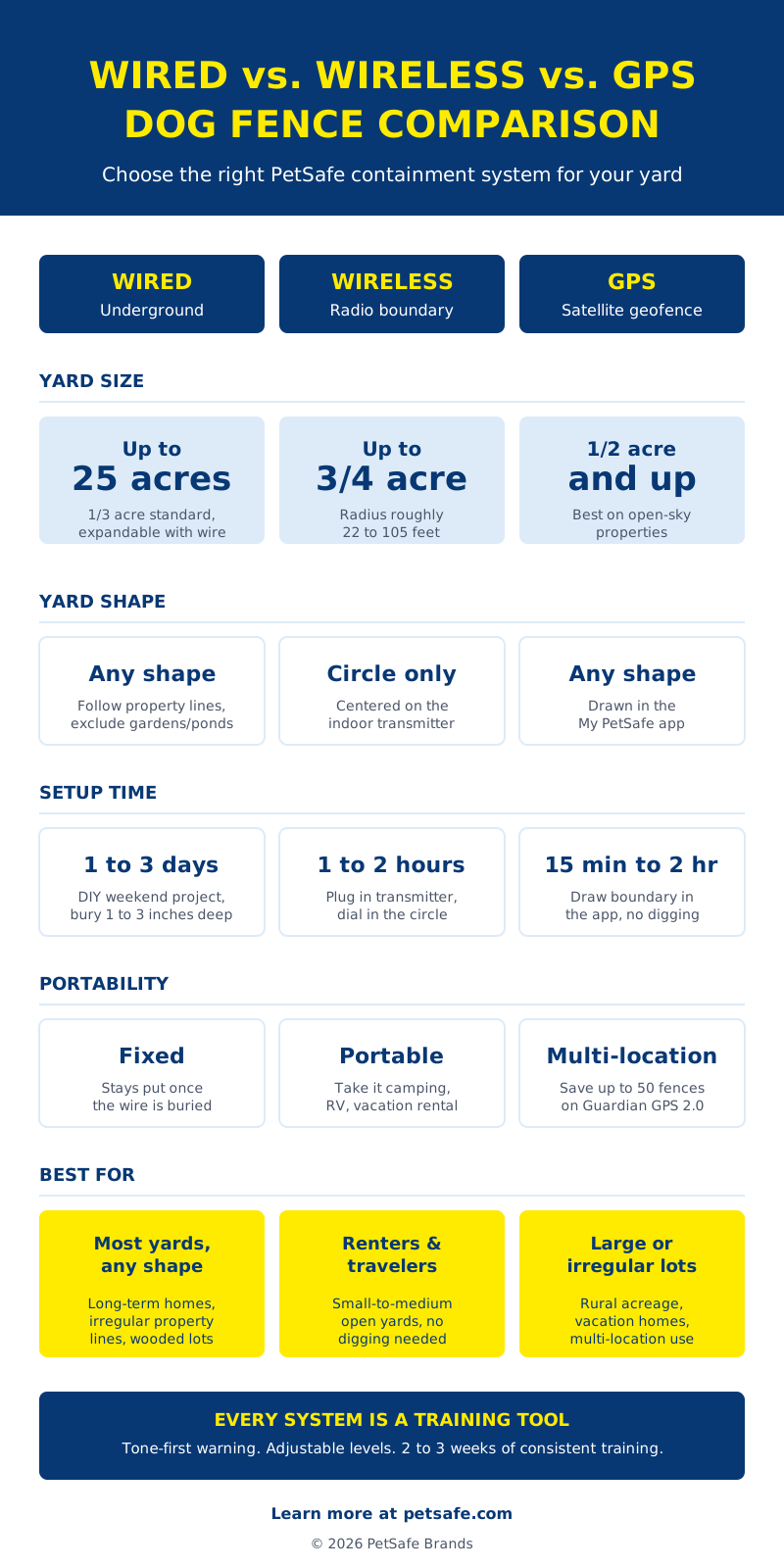
Three different technologies, three different sweet spots. Here is a quick side-by-side to orient you before we look at each in detail.
- Wired underground fence: a buried boundary wire covers up to 25 acres in any shape you can dig, installs in 1 to 3 days as a DIY project, and stays put. Best for most yards, any shape, any terrain.
- Wireless pet fence: an indoor transmitter creates a circular boundary of up to 3/4 acre, installs in 1 to 2 hours with no digging, and is fully portable. Best for renters, travelers, and small-to-medium open yards.
- GPS pet fence: a satellite geofence drawn in an app covers 1/2 acre and up in any shape, sets up in 15 minutes to 2 hours with no digging, and can be moved between locations. Best for large or irregular properties with open sky.
The graphic below sums up the same comparison across the five factors that matter most when you are choosing.
How does a wired underground fence work?
A wired underground fence, sometimes called an in-ground fence or a hidden fence, is the oldest and most established electronic containment technology. It uses four pieces working together:
- A transmitter plugged in inside your garage, basement, or another sheltered spot.
- A boundary wire buried a few inches underground around the edge of your yard, forming a complete loop back to the transmitter.
- A receiver collar worn by your dog that picks up the boundary signal.
- Training flags placed along the boundary during the first two to three weeks so your dog can see where the line is.
The transmitter sends a coded radio signal through the buried wire. When your dog gets close to the wire, the collar hears the signal and warns with a tone. If your dog keeps moving toward the boundary, the collar delivers a brief, adjustable static correction. Your dog quickly learns to associate the tone with the boundary and to turn back before any correction happens.
Independent testing site iHeartDogs.com has called PetSafe's in-ground fencing "the most reliable electronic dog fence" for backyards, citing the adjustable circular perimeter, waterproof collar, and automatic shut-off feature. [1]

Advantages of a wired underground fence
- Any yard shape, any size: because you decide where the wire goes, you can contour the boundary around gardens, ponds, driveways, and irregular property lines. Standard kits cover up to 1/3 acre and expand with additional wire to 25 acres or more.
- Consistent boundary: the signal follows the wire exactly and does not shift with weather, tree cover, or nearby buildings.
- Works on any terrain: hills, woods, slopes, and rural properties are all fair game.
- One-time setup: once the wire is buried, it stays put for years. Some pet parents keep the same system running for a decade or more with only occasional collar-battery replacements.
- Trusted by testers: Field & Stream named PetSafe's Stubborn Dog In-Ground Pet Fence its "Best Overall" electronic dog fence pick after testing it against several major brands. [2]
Trade-offs to know
- Installation is a weekend DIY project. Most owners lay wire around the perimeter and either bury it 1 to 3 inches deep or staple it to an existing physical fence.
- Once installed, the system is not portable. Taking it to a rental or vacation home means digging a new loop.
- If the wire is ever cut (a landscaper, a shovel, tree roots), the loop needs to be spliced back together to restore the signal. Most PetSafe transmitters include a wire-break alarm so you know immediately.
How do you install an in-ground fence, and what wire gauge do you need?
Most PetSafe in-ground kits ship with 500 feet of 20-gauge solid-core boundary wire, which is the right choice for the vast majority of yards. If you are running the wire through very rocky soil or using an industrial trencher, stepping up to a heavier 16-gauge wire adds durability. If you are pairing the fence with an existing physical fence, you can attach the wire to the fence instead of burying it. For the full step-by-step, our companion guide on training your dog to a new containment system walks through installation and the boundary-training routine together.
How does a wireless pet fence work?
A wireless pet fence trades the buried wire for a small transmitter that sits indoors and broadcasts a circular radio signal around itself. Anywhere the signal reaches becomes the safe zone; when your dog gets close to the edge of the circle, the receiver collar warns with a tone, then delivers a gentle correction if your dog continues past the boundary.
Because the boundary is created by radio waves rather than a physical wire, there is no digging and no landscaping to worry about. Most PetSafe wireless systems set up in 1 to 2 hours: plug in the transmitter, dial in the size of the circle, and walk the perimeter with the collar and training flags to mark it visually for your dog.
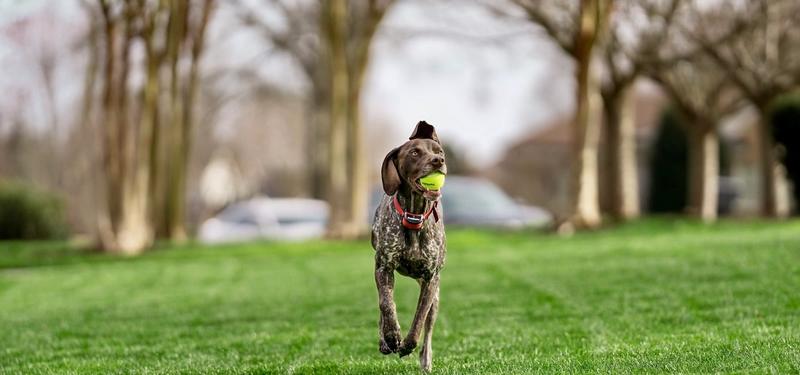
Advantages of a wireless fence
- Fast setup: most kits are ready to train on the same afternoon they arrive.
- No digging: ideal for rocky soil, HOA restrictions, rental properties, or anyone who does not want to touch a shovel.
- Portable: unplug the transmitter, pack it in the RV or a vacation rental, and set up a new safe zone anywhere with an outlet. Many pet parents use a wireless fence exclusively for camping and travel.
- Static-free re-entry: if your dog ever slips past the boundary, most PetSafe wireless systems let them back inside without another correction, so your dog is never afraid to come home.
- Editorial recognition: Forbes Vetted named PetSafe's Wireless Pet Containment System its "Best Wireless Dog Fence Overall" and PetSafe's Stay & Play® Wireless Fence for Stubborn Dogs its "Best Wireless Fence For Persistent Dogs" after consulting canine behavior experts. [3]
Trade-offs to know
- Circular only: the boundary is a circle centered on the transmitter, so it may cross a driveway, part of the road, or a neighbor's yard depending on where the transmitter sits. A rectangular yard will always have unused corners.
- Size cap: the largest PetSafe wireless boundary covers about 3/4 acre. Bigger properties need in-ground or GPS.
- Terrain and metal can interfere: thick concrete walls, metal roofing, aluminum siding, and large metal appliances near the transmitter can distort the signal. Placement matters.
Can I take a wireless fence camping or traveling?
Yes, and this is one of the biggest reasons pet parents choose wireless. Pack the transmitter with its power adapter, a fresh set of training flags, and the collar. Once you arrive, place the transmitter indoors at least 3 feet from metal objects, plug it in, and dial in the circle. Walk the new boundary with your dog on-leash a few times, place the flags as a visual reminder, and your dog has a familiar safe zone in an unfamiliar place. If you are staying in a metal-roofed RV or cabin, expect the maximum circle to shrink somewhat and re-check the boundary before letting your dog off-leash.
How does a GPS pet fence work?
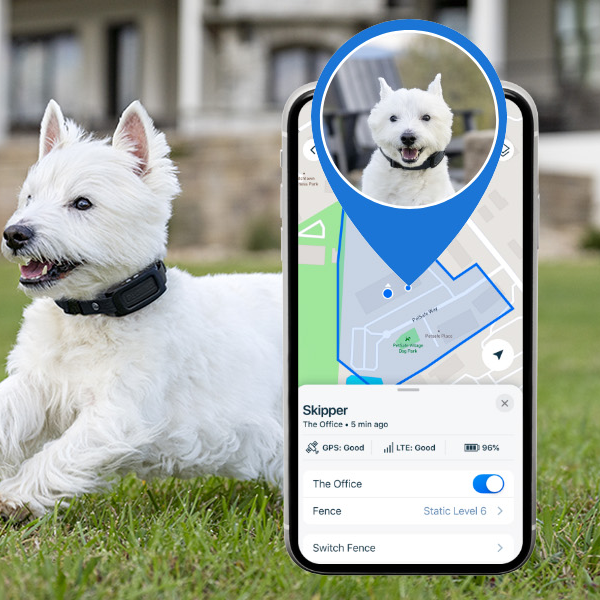
A GPS pet fence throws out the transmitter entirely. Instead, the receiver collar itself talks to satellites and maps its position against a boundary you draw on a map in a mobile app. That means you can create any shape of boundary you want, over any size property, without digging a single foot of wire.
PetSafe's Guardian® GPS lineup uses a technology called AccuGuard™, which combines GPS satellite data with real-time motion detection and on-board processing to keep the boundary accurate even when your dog is moving fast. The premium Guardian® GPS 2.0 Dog Fence + Tracking adds dual-frequency GPS (using both L1 and L5 satellite bands) for the most accurate reading available, and stores up to 50 different saved fences so you can move between home, a vacation property, or a friend's yard without redrawing.
After testing Guardian GPS 2.0 with a small, curious Prague Ratter, Vetstreet reported that "we were able to pair the collar and set up our first virtual fence in moments" and praised the dual-frequency GPS as "the most accurate and reliable signal in the industry." [4]
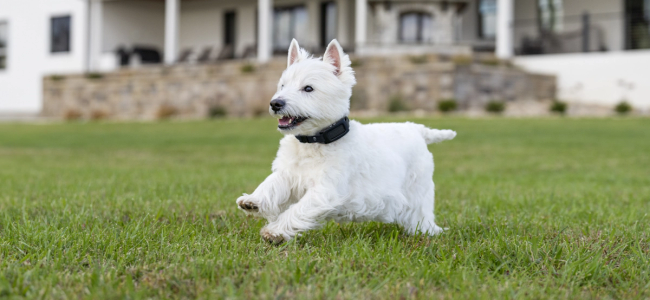
Advantages of a GPS fence
- Any shape, any size: draw a rectangle, a curve, or a complex outline that follows your actual property line, all through your phone.
- No digging, no transmitter to place: the whole system lives in the collar and the app.
- Multi-location fences: save several different fences and switch between them. Great for pet parents with a lake house or who travel with their dog.
- Real-time tracking (on select models): premium GPS fences send you an alert if your dog leaves the boundary and let you see their location on a map.
Trade-offs to know
- Property size minimum: GPS works best on properties of 1/2 acre or larger. Smaller yards are better served by a wireless or in-ground fence.
- Open sky matters: dense tree cover, tall buildings, and metal roofing overhead can slow the collar's satellite fix. Dual-frequency GPS handles this far better than single-frequency systems, but a wide-open sky is always the best case.
- Pet size and neck fit: GPS collars are larger than in-ground or wireless receivers because they hold a GPS radio and a rechargeable battery. Check the collar's recommended pet weight and neck-size range before you buy.
- Charging cadence: GPS collars run on rechargeable batteries measured in days, not months. Building "charge the collar every night" into your routine is essential.
- Subscription (on tracking models): the Guardian GPS 2.0 + Tracking model requires a subscription for the live tracking feature, which includes a free trial. The subscription-free Guardian® GPS Dog Fence gives you the same containment technology without live tracking.
When is GPS the most reliable choice?
GPS earns its keep on properties that are too big or too oddly shaped for a wireless circle and too much work to trench for in-ground wire, especially rural acreage, wooded lots, and vacation homes. It is also the only technology that lets you keep tabs on your dog's location in real time, which is valuable for high-adventure households and for dogs with strong wandering instincts. For a deeper look at PetSafe's tracking-enabled system, see our companion guide to the best GPS dog fence with Guardian tracking.
Wired vs. wireless vs. GPS: which is best for your dog?
The right choice comes down to five questions about your yard and your dog. Work through them in this order.
- How big is your yard? Under 3/4 acre: wireless or in-ground. 3/4 to 25 acres and any shape: in-ground. 1/2 acre and up, with open sky: GPS.
- What shape is your yard? A circle around your house works: wireless is on the table. You need to follow an irregular property line or exclude a garden or pond: in-ground or GPS.
- How much time do you want to spend setting up? An afternoon: wireless or GPS. A weekend: in-ground.
- Do you rent, travel, or move often? Yes: wireless or GPS. No: in-ground is a fine long-term investment.
- How big is your dog? Very small pets (under about 8 pounds) do best with a lightweight in-ground or wireless collar. Larger dogs have the widest range of options, including GPS.
Best for small and standard suburban yards
A wireless fence is the easiest all-around answer. Setup takes an hour or two, you never touch a shovel, and the circular boundary comfortably covers most suburban lots. If your yard is a rectangle or an odd shape, an in-ground fence gives you cleaner coverage and more usable space.
Best for large or irregular properties
Two strong choices, depending on how much work you want to do upfront. An in-ground fence expands to 25 acres and traces any boundary you can dig; it is the most consistent and durable option once installed. A GPS fence gives you the same shape flexibility with no digging, plus the ability to save multiple fences for different locations. On very wooded rural properties, in-ground is usually more reliable because it does not depend on satellite reception.
Best for renters, travelers, and vacation homes
Portability rules out in-ground. Choose wireless if you want the simplest, most affordable travel-ready system, or GPS if you have a large or oddly shaped property at your destination and want to save multiple fences in the app.
Electronic containment vs. a traditional physical fence
A physical fence is a physical barrier: nothing gets in or out unless a gate is open. That is a genuine advantage for households with predators nearby, deliveries in and out all day, or a dog with a very high prey drive. But physical fences are expensive, often restricted by HOAs or historic districts, and require ongoing maintenance for rot, rust, and gaps. Electronic containment is dramatically less expensive and works on almost any property. Many pet parents combine both: a physical fence around a smaller inner yard for potty breaks and predator protection, with an electronic fence around the full property so the dog can safely roam a larger area.
Can I use an electronic dog fence for my cat?
Yes, the technology is the same as the dog version, with a critical difference at the collar. Look for a cat collar includes a stretch/breakaway safety section so that if your cat gets snagged on a branch or a fence, the collar releases rather than catching. A cat-specific collar is also smaller and lighter to fit feline necks, and it is designed to work with cats 6 pounds and up who are at least 6 months old.
A few important cautions before you buy for a cat:
- Cats are not small dogs. Some cats respond very well to boundary training; others become startled and bolt through a boundary rather than retreat. Your cat's temperament matters far more than it does with a dog.
- Wireless is not the best fit for most cats. The circular boundary and the size of the collar make in-ground the stronger cat choice. If you do use a wireless system with a cat, order the separately sold cat collar strap and start with tone-only training.
- Wire placement is critical. Route the boundary wire well inside anything a cat could climb (fences, sheds, trees) to jump the boundary from above.
- Talk to your vet. Cats with anxiety, high prey drive, or a history of running when startled may be better served by a physical enclosure or a supervised harness routine.
Containment for hunting and sporting dogs
Working dogs on serious acreage need a containment system built for the field. That is where SportDOG®, PetSafe's sister brand, comes in. Its in-ground fence lineup is engineered for hunting, working, and field-trial dogs, and starts with 1,000 feet of boundary wire that contains up to 1 1/3 acres out of the box and expands to as much as 100 acres. The collar is submersible, offers seven static levels plus tone and vibration, and is built to hold up in the field. If your dog's job description includes long hours running rural land, SportDOG is worth a look alongside the PetSafe options above.
Are electronic dog fences safe and humane?
The short answer is yes, when the system is used as a training tool, the correction is set at the lowest level that gets your dog's attention, and the boundary training is done consistently over a few weeks. Every PetSafe containment system is designed with the same training-first philosophy: the collar always warns your dog with a tone (and often a vibration) before any static correction, and both the warning and the correction levels are adjustable. Many pet parents train and maintain their dogs successfully on tone-only mode.
A few things that make a real difference to safety and outcomes:
- Pair the fence with reward-based training. The American Veterinary Society of Animal Behavior recommends reward-based methods as the foundation of any dog training. [5] Use the boundary as a signal to turn back, and reward your dog generously the moment they do.
- Start with tone only. Every PetSafe system offers a tone-only mode. Begin there. Only increase to a static level if your dog is ignoring the tone, and always use the lowest level that gets a response.
- Use the training flags for at least two to three weeks. Flags give your dog a visual boundary while they learn the audible one. Do not remove them early.
- Fit the collar correctly. The contact points should touch the skin snugly (you should be able to slide one finger under the strap). A loose collar delivers inconsistent signals.
- Know who these systems are not for. Dogs with very high prey drive that will bolt through any correction, anxious or fearful dogs, dogs with certain medical conditions, and puppies under 6 months are generally not good candidates. Talk to your veterinarian or a certified trainer if you are unsure.
- A containment fence is not a physical barrier. Other animals and people can still enter your yard, and your dog is not protected from theft. Supervise as you would with any yard-based system.
Do electronic dog fences work? The evidence in the field says yes: hands-on reviewers at Field & Stream, Forbes Vetted, Vetstreet, and iHeartDogs have all tested PetSafe containment systems on their own dogs and reported successful boundary training. [1][2][3][4] The most common reason a system fails is not the collar; it is training that was cut short. Give it the two to three weeks it needs.
How to train your dog to a new containment system
The high-level shape of training is the same regardless of which technology you choose:
- Week 1: Introduce the flags with your dog on-leash and in tone-only mode. Walk the boundary together. When the tone sounds, praise your dog for backing away.
- Week 2: Increase distractions (a treat or toy just outside the boundary) while still on-leash. Reward every time your dog turns back on the tone.
- Week 3 and beyond: Move to off-leash supervised time inside the yard. Continue to reinforce the boundary with praise and reward. Gradually remove the flags over the next two to three weeks.
For the full step-by-step, our companion guide walks through training your dog to a new containment system day by day.
Frequently asked questions
What is the difference between a wireless and a GPS dog fence?
A wireless dog fence uses an indoor transmitter that broadcasts a circular radio boundary around your home, up to about 3/4 acre. A GPS dog fence uses satellites and a mobile app to draw any shape of boundary over larger properties, typically 1/2 acre and up. Wireless is best for small-to-medium open yards; GPS is best for large or irregular properties with open sky.
Which is better, a wired or wireless dog fence?
Wired is more consistent, covers more area (up to 25 acres), and lets you contour any shape of boundary; it takes a weekend to install. Wireless is faster to set up (1 to 2 hours) and fully portable, but the boundary is a circle and caps at about 3/4 acre. If you want the most reliable, largest-coverage option and do not need to move it, choose wired. If you want fast setup or portability, choose wireless.
How does an electronic fence work?
A wired electronic fence uses a buried boundary wire connected to a transmitter that sends a radio signal; a lightweight receiver collar detects the signal near the boundary and warns your dog with a tone before a gentle static correction. Wireless and GPS versions replace the wire with a transmitter-generated circle or a satellite geofence, but the receiver-collar logic is the same.
Do electronic dog fences actually work?
Yes, when they are paired with proper boundary training. Most dogs learn a new boundary in two to three weeks of consistent, on-leash training with flags. The most common cause of a fence not working is training that was cut short or a collar that was fit too loosely to make contact.
Are electronic dog fences safe for dogs?
PetSafe containment systems are designed with adjustable correction levels, a tone-first warning, waterproof collars, low-battery indicators, and automatic time-outs that end the correction if your dog crosses the boundary. Used at the lowest effective level and paired with reward-based training, they are considered safe for most healthy adult dogs. Dogs with high prey drive, significant anxiety, certain medical conditions, or under six months of age may not be good candidates; talk to your veterinarian if you are unsure.
Are electronic fences humane?
The humane answer lies in how the system is used. When the fence is treated as a training tool, the correction is set at the lowest effective level, training uses flags and reward-based methods over several weeks, and the dog is a good behavioral candidate, most trainers and veterinarians consider it a humane containment option. Reward-based training pairing is strongly recommended.
What size yard do I need for a GPS dog fence?
PetSafe recommends a property of at least 1/2 acre for a GPS fence to work reliably. Very small yards are better served by wireless or in-ground systems. Open sky improves accuracy; heavy tree cover or tall buildings can slow the collar's satellite fix.
Can I use an electronic fence for a cat?
Yes. Cats respond differently than dogs to boundary training; some do well, others startle and bolt through the boundary. In-ground is generally a better fit for cats than wireless, and any cat system should be paired with tone-first training and a conversation with your veterinarian.
How long does it take to train a dog to a containment fence?
Most dogs learn a new boundary in two to three weeks of short, consistent, on-leash training sessions with boundary flags. Off-leash freedom follows once your dog is reliably turning back on the tone. Puppies, rescues, and dogs new to any training may need longer.
Do PetSafe fences require a subscription?
PetSafe in-ground and wireless fences do not require any subscription. The Guardian® GPS Dog Fence (containment only) is subscription-free. The premium Guardian® GPS 2.0 Dog Fence + Tracking requires a subscription for the live tracking feature and includes a free trial.
What is a static correction, and does it hurt my dog?
A static correction is a brief, adjustable pulse (similar in feeling to the small static shock you get from a doorknob on a dry day) delivered through two contact points on the collar. It is designed to get your dog's attention, not to hurt them. Correction levels are adjustable across every PetSafe system, and every system also offers a tone-only mode that many pet parents use exclusively.
Can I take a wireless dog fence with me when I travel?
Yes. Wireless fences are designed for portability. Pack the transmitter, its power adapter, the collar, and a set of training flags. Set the transmitter indoors at your destination, plug it in, dial in the circle, and walk the new boundary with your dog on-leash a few times before letting them run.
How do I maintain my containment fence through the seasons?
Wired in-ground fences are largely maintenance-free once installed. Twice a year, walk the boundary and look for any signs of exposed wire or damage from landscaping. In winter, keep the transmitter indoors in a dry, temperate spot; deep frost rarely bothers buried wire but the transmitter should never sit in freezing conditions. For wireless and GPS systems, inspect the collar contacts monthly, replace or recharge batteries on schedule, and re-test the boundary after any home electrical work, new appliances, or storms that might have affected the signal.
Citations and sources
- iHeartDogs. "Dog Fences: Professional Installation vs DIY Testing." iheartdogs.com
- Field & Stream. "The Best Dog Fences That Actually Worked With My Lab." fieldandstream.com
- Forbes Vetted. "4 Best Wireless Dog Fences And What To Know Before Getting One." forbes.com
- Vetstreet. "PetSafe GPS Dog Fence 2.0 + Tracking: Our In-Depth Review." vetstreet.com
- American Veterinary Society of Animal Behavior. "Position Statement on Humane Dog Training." avsab.org
About the author
PetSafe® Guest. This article was reviewed and published by the PetSafe editorial team, drawing on more than 30 years of experience helping pet parents keep their dogs and cats safe at home. For product questions, contact PetSafe Customer Care.
Last Modified: 2026-08-03


Get Email Updates
Subscribe to the latest news, promotions, & more from PetSafe® brand.
Sign up today for the latest news, promotions, and more from PetSafe® brand.