August 11, 2026
PetSafe® Expert
PetSafe® Guest
How Often Should I Feed My Cat? A Complete Feeding Chart by Life Stage
Key Points
- Most healthy adult cats should be fed at least two meals a day, roughly 8 to 12 hours apart.
- Kittens up to six months old need three to four small meals a day; kittens six to twelve months old shift to twice-daily feeding.
- Senior cats generally do well on the same twice-daily schedule as adults, though some benefit from smaller, more frequent meals.
- A cat's stomach empties within a few hours, and after 8 to 10 hours, hunger signals kick in, which is why one meal a day is rarely enough.
- Free feeding drives obesity in many cats; the Association for Pet Obesity Prevention estimates that 61% of U.S. cats are overweight or obese.
- Adjust frequency and portion size based on your cat's age, weight, activity level, and any medical conditions, and check with your veterinarian.
Table of Contents
- How often should I feed my cat? The quick answer
- Cat feeding frequency chart by life stage
- Why feeding frequency matters
- Meal feeding, free feeding, or combination feeding?
- What time of day should I feed my cat?
- How feeding frequency ties to portion size and calories
- Feeding cats in multi-cat households
- Automatic feeders, puzzle feeders, and slow feeders
- Special situations: medical conditions and medication
- How to change your cat's feeding schedule
- Frequently asked questions
- Citations and sources
How often should I feed my cat? The quick answer
Most healthy adult cats should be fed at least twice a day, about 8 to 12 hours apart. Kittens need more frequent meals because they are growing quickly and have small stomachs, and senior cats often do well on the same twice-daily rhythm they had as adults, sometimes broken into a few smaller portions.
That baseline works for the majority of cats, but the right frequency for yours depends on age, body condition, activity level, food type, and any medical needs. The chart below breaks down what most veterinarians recommend by life stage.
Cat feeding frequency chart by life stage
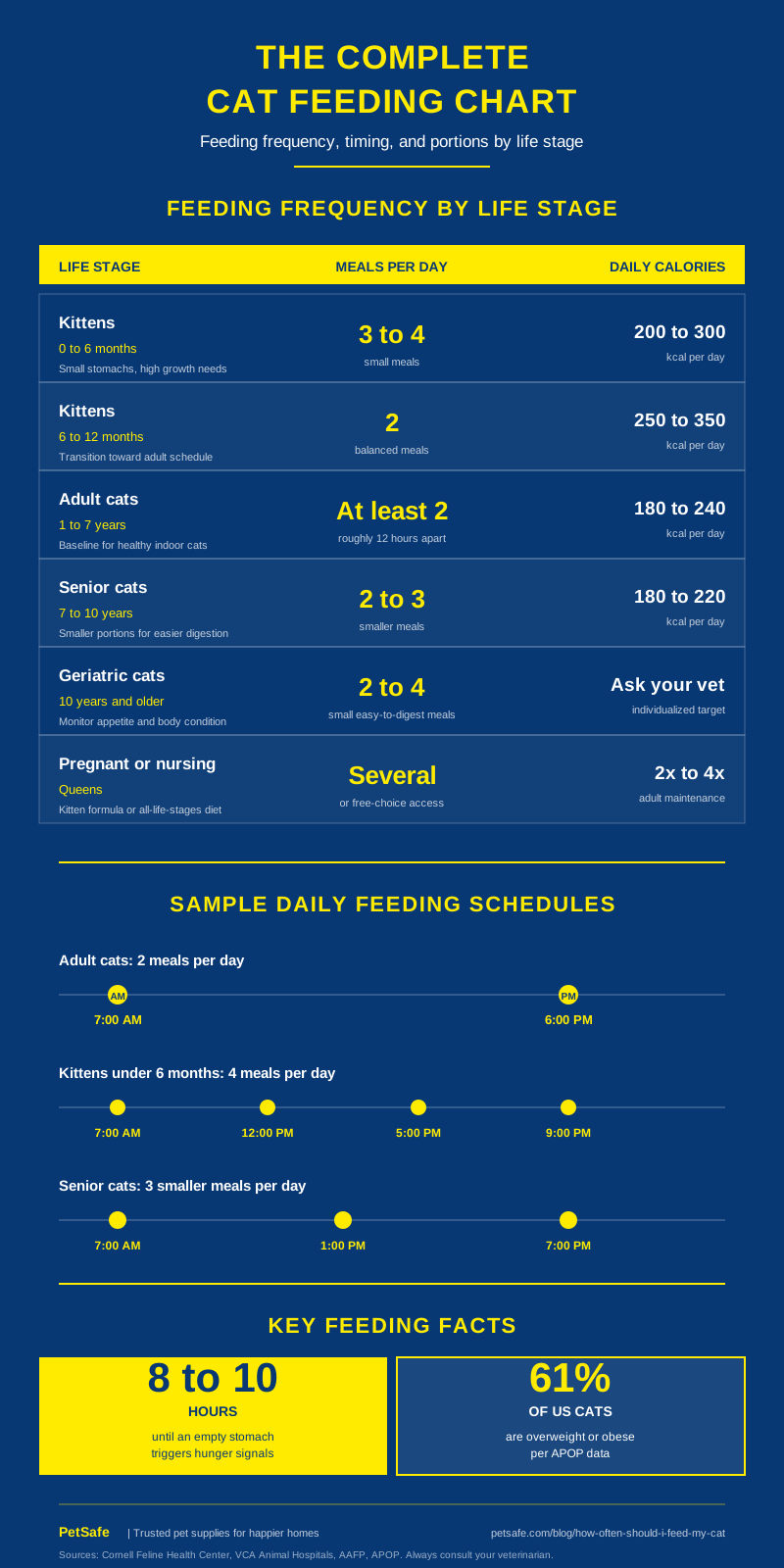
The recommendations below reflect the current consensus from Cornell Feline Health Center, VCA Animal Hospitals, and the American Association of Feline Practitioners. Use them as a starting point, then adjust with your veterinarian based on your cat's body condition and health.
- Kittens (up to 6 months): 3 to 4 meals per day
- Kittens (6 to 12 months): 2 meals per day
- Adult cats (1 to 7 years): At least 2 meals per day
- Senior cats (7 to 10 years): 2 to 3 smaller meals per day
- Geriatric cats (10+ years): 2 to 4 small, easy-to-digest meals per day
- Pregnant or nursing cats: Several small meals a day or free-choice access to food
Kittens (0 to 12 months)
Kittens grow quickly and burn a lot of energy, but their stomachs are tiny, so they need small meals spread throughout the day. From weaning at around eight weeks up to six months of age, three to four measured meals a day works well [1]. Between six months and their first birthday, most kittens can transition to two meals a day. Free feeding a kitten the whole day's ration at once is not recommended: it encourages binge eating and can set the stage for obesity, joint problems, and diabetes later in life [2].
Adult cats (1 to 7 years)
Once a cat reaches about one year old, at least two meals a day is the standard recommendation [1][2]. Some cats prefer three or four small meals, especially if they beg between larger meals. What matters most is that the total daily calorie intake is measured and appropriate for your cat's body condition.
Senior and geriatric cats (7+ years)
The definition of "senior" varies. Cornell Feline Health Center considers senior cats to be 10 years and older and recommends maintaining the same adult feeding regimen unless a veterinarian advises otherwise [1]. Practices following American Animal Hospital Association and American Association of Feline Practitioners life stage guidelines consider cats seven and older to be entering their senior years [3]. In practice, seniors often do well with two or three smaller meals a day, particularly if they have reduced appetite, dental discomfort, or slower digestion.
Pregnant and nursing cats
Pregnant queens, especially in the final trimester, and nursing mothers have dramatically higher energy needs than typical adult cats. Most guidance calls for several small meals a day or free-choice access to a kitten-formula or all-life-stages diet during pregnancy and lactation [2]. Ask your veterinarian for a specific plan based on litter size and body condition.
Why feeding frequency matters
Cats have a simple stomach anatomy that empties within a few hours after a meal as food moves into the small intestine. After about 8 to 10 hours, an empty stomach begins to send hunger signals to the brain [2]. That is one of the main reasons veterinarians recommend at least two meals a day: a single daily meal leaves cats in a fasted state long enough to cause stomach upset, vomiting yellow bile, and irritability at the food bowl.
"After 8 to 10 hours, an empty stomach begins to send signals to the brain that stimulate a hunger response. For this reason, at least two meals per day are best for your cat."
Going too long without food carries a real medical risk on the other end. If a cat stops eating for several days, the liver can start mobilizing fat for energy and develop hepatic lipidosis, a serious condition that requires veterinary care [4]. This risk is highest in overweight cats.
Frequency matters for behavior, too. A 2018 consensus statement from the American Association of Feline Practitioners noted that free-living cats eat roughly 12 to 20 small meals across a 24-hour period, and that one or two large bowl meals a day fails to meet cats' behavioral needs [5]. Many veterinarians now suggest breaking daily portions into more frequent small meals or offering some of the ration through puzzle feeders.
Meal feeding, free feeding, or combination feeding?
There are three main approaches to feeding a cat, and each has trade-offs. The right style depends on your schedule, whether you have more than one cat, whether any pet has a medical condition, and how well your cat regulates its own intake.
Meal feeding means offering measured portions at scheduled times, usually twice a day for adults and more often for kittens. The main benefit is control: you know exactly how much your cat is eating, and any appetite change is immediately obvious, which is often the first sign a cat is unwell. The downside is that it requires you to be home at meal times, or to use a programmable feeder when you are away.
Free feeding means leaving dry food out all day for your cat to graze on. Some cats regulate their intake well enough to stay lean this way, but most do not, and free feeding is a common driver of feline obesity. It also makes subtle appetite changes hard to spot and is not appropriate for cats with diabetes, kidney disease, hyperthyroidism, or any condition where portion control matters. Wet food should never be free fed because it spoils within a couple of hours at room temperature.
Combination feeding pairs measured wet food meals with a small amount of dry food available to graze or offered through a puzzle feeder. It captures the hydration and portion-control benefits of wet food while giving cats the psychological comfort of nibbling between meals. It does require careful accounting so both food sources together add up to the correct daily calorie target.
For most cats, meal feeding or combination feeding is safer than pure free feeding.
What time of day should I feed my cat?
Cats are crepuscular, meaning they are naturally most active around dawn and dusk. Feeding schedules that mirror that rhythm, with a morning meal shortly after you wake up and an evening meal a few hours before bed, fit cats' instincts well. A common two-meal schedule is 7 a.m. and 6 p.m. Kittens on a four-meal schedule might eat at 7 a.m., noon, 5 p.m., and 9 p.m.
Consistency matters more than the exact clock time. Cats are creatures of habit, and a predictable schedule provides security that helps with everything from transitioning to a new food to coping with household changes like a new baby, a house guest, or a move [2]. If your work schedule makes fixed meal times difficult, a programmable, portion-control automatic feeder can hold the routine steady on your behalf.
How feeding frequency ties to portion size and calories
Meal frequency and portion size are two sides of the same equation. The total daily calories your cat needs stays roughly the same whether you split it across two meals or four; what changes is how much food goes in the bowl at each meal.
A veterinary rule of thumb is that a healthy adult indoor cat needs about 20 kilocalories per pound of ideal body weight per day, so a 10-pound cat needs roughly 200 kilocalories daily. Kittens need two to three times as much per pound, seniors often need slightly less, and pregnant or nursing queens need much more. Body condition, activity level, spay or neuter status, and food type all shift the number.
The safest approach is to weigh your cat, agree on an ideal body weight target with your veterinarian, check the calorie information on your food's label, and divide the daily target across the number of meals. If you're not sure whether your cat is at a healthy weight, our companion guide on how much your cat should weigh walks through body condition scoring in detail. Overfeeding is the most common mistake, and it is easy to do when you feed for your cat's current weight rather than an ideal target weight.
Feeding cats in multi-cat households
Feeding two or more cats under one roof adds real complexity. Cats are solitary hunters by nature and prefer to eat alone in a quiet spot where they feel safe. Grouping food bowls together, especially near a busy hallway or a noisy appliance, can create low-grade stress that affects how much each cat eats.
The American Association of Feline Practitioners recommends offering multiple food and water stations spread across a home, ideally on different floors or in different rooms, so cats can eat without conflict [5]. As a general rule, plan for at least one feeding station per cat, plus one extra, and keep them well apart from litter boxes.
Multi-cat homes also make portion control harder. If one cat is on a weight-loss plan or a prescription diet and another is a healthy grazer, a shared bowl guarantees the wrong cat will eat the wrong food. Kittens and senior cats often need different foods entirely, and neither should be free fed from the same bowl. The most reliable fixes are meal feeding in separate rooms with the doors closed, elevated feeding stations that only an agile younger cat can reach, and programmable, portion-control feeders that dispense a measured meal at a set time and stop.
Watch for signs that one cat is bullying another away from food: cats that eat too fast, stop eating in the presence of a housemate, guard the food area, or lose or gain weight unexpectedly are all clues the current setup needs adjustment.
Finally, keep water separate from food. Cats often prefer to drink away from where they eat, and a cat water fountain in a different room from the food bowls tends to increase daily water intake, which is especially important for cats on dry-food-heavy diets.
Automatic feeders, puzzle feeders, and slow feeders
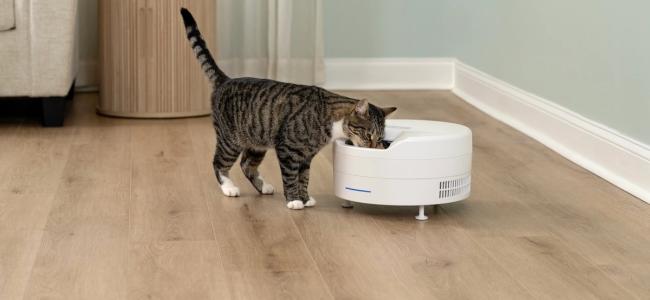
An automatic cat feeder can hold a scheduled feeding routine steady when you cannot be home, and a programmable, portion-control model lets you split a day's ration into as many small meals as your cat benefits from. The American Association of Feline Practitioners lists automatic feeders alongside puzzle feeders and multiple food stations as acceptable tools for meeting cats' behavioral feeding needs [5].
Programmable, portion-control feeders are especially useful for households where one cat needs measured meals for weight management, cats on prescription diets, cats on medications timed with food, and homes where nobody is around at natural cat meal times. Look for feeders that let you preset small portion sizes and multiple meals per day rather than gravity-drop models that empty the bowl in one sitting.
Puzzle feeders and slow feeders solve a different problem. They turn a meal into a foraging exercise, which slows down fast eaters, provides mental enrichment, and taps into cats' natural drive to hunt for food. Even a simple homemade version, like a clean muffin tin with a piece of dry food in each cup and a ping pong ball on top, can turn a bowl meal into a satisfying puzzle.
Special situations: medical conditions and medication
Diabetic cats typically receive insulin injections twice a day, and most veterinarians time meals to those injections, roughly 12 hours apart, so that food and insulin work together [1]. Many diabetic cats do best on a moderately carbohydrate-restricted diet, and your veterinarian may recommend feeding a partial meal before dosing so an off day at the bowl can be caught before the insulin is given.
Cats with chronic kidney disease often benefit from smaller, more frequent meals of a phosphorus-restricted diet to reduce nausea and preserve appetite; wet food is usually preferred because it supports hydration. Hyperthyroid cats may have a huge appetite but lose weight, and typically need frequent meals of a controlled diet until their thyroid is stabilized. Cats with feline lower urinary tract disease benefit from wet food and multiple water stations to keep urine dilute.
Cats recovering from surgery, dental procedures, or gastrointestinal illness often do best with several small, easy-to-digest meals a day, at least during recovery. Always follow the specific plan your veterinarian gives you, and reach out promptly if your cat refuses food for more than a day.
How to change your cat's feeding schedule
Cats do not love change, but they adapt well to feeding schedule shifts if you go gradually. Whether you are moving from free feeding to meal feeding, adding a meal for a growing kitten, or scaling back for a senior cat, a one to two week transition works better than a sudden switch.
Start by measuring what your cat currently eats in a full day. If you have been free feeding, pour the day's ration into a measuring cup in the morning and refill only from that amount. Once you have the baseline, split it into the number of meals you want to end up at, and offer each portion at what will become the new meal times. In the first few days, leave food out for about 30 minutes at each meal and then pick it up, so your cat learns that food arrives on a schedule.
Expect some meowing in the first week. Do not add extra food between meals; a hungry cat before a scheduled meal is the whole point. Track your cat's weight weekly during any schedule change. A little fluctuation is normal, but consistent weight loss or gain over two to three weeks is a signal to adjust portions or check in with your veterinarian.
Frequently asked questions
How often should you feed an indoor cat?
Indoor adult cats generally do best on at least two meals a day, roughly 8 to 12 hours apart. Because indoor cats are less active than outdoor cats, portion sizes need to reflect their sedentary lifestyle.
What is the 3-3-3 rule for cats?
The 3-3-3 rule is an adoption adjustment framework, not a feeding schedule. It describes what to expect from a newly adopted cat: about three days to decompress, three weeks to start settling into a routine, and three months to feel fully at home. During the first three days, most cats hide and eat very little, which is normal.
Is 1 cup of food too much for a cat?
For most adult cats, one full cup of dry food per day is too much. A 10-pound indoor cat needs roughly 200 calories a day, which usually works out to about one-third to one-half cup of dry food. Always check the calorie information on your specific food's label.
Do cats stop eating when they are full?
Some cats self-regulate well, but many do not. When a full bowl is always in front of them, plenty of cats will overeat, which is a major reason free feeding is associated with obesity.
How many times a day should I feed my cat?
Twice a day is the baseline for healthy adult cats. Kittens under six months need three or four meals, senior cats often benefit from two or three smaller meals, and cats with certain medical conditions may need a more frequent schedule.
Should I leave food out overnight?
Wet food should never be left out overnight because it spoils and attracts insects. Dry food can be left out safely, but doing so is essentially free feeding. A safer alternative is a portioned evening meal plus a programmable feeder set to dispense a small pre-breakfast portion at a set time.
How often should I feed a kitten?
Kittens up to six months old typically need three to four small meals a day. Between six months and their first birthday, most kittens can move to twice-daily feeding.
Can I feed my cat only once a day?
A few cats do fine on one meal a day, and a 2020 University of Guelph study found some metabolic differences in cats fed once versus four times daily. Still, the mainstream veterinary recommendation is at least two meals a day for most cats, because a single meal leaves a cat in a fasted state long enough to trigger significant hunger.
How long can a cat go without eating?
A healthy adult cat can technically survive several days without food, but going more than 24 to 48 hours without eating is a medical concern. Overweight cats that stop eating are at particular risk for hepatic lipidosis. Contact your veterinarian if your cat refuses food for more than a day.
Should senior cats eat more often?
Not necessarily more often, but often in smaller portions. Many seniors do well on the same twice-daily schedule they had as adults. If your senior cat has dental issues, digestive slowdown, or a chronic condition, two or three smaller meals may be more comfortable.
Citations and sources
- Cornell Feline Health Center. "How Often Should You Feed Your Cat?" vet.cornell.edu
- VCA Animal Hospitals. "Feeding Times and Frequency for Your Cat." vcahospitals.com
- American Animal Hospital Association / American Association of Feline Practitioners. "2021 AAHA/AAFP Feline Life Stage Guidelines." aaha.org
- Merck Veterinary Manual. "Hepatic Lipidosis in Small Animals." merckvetmanual.com
- American Association of Feline Practitioners. "Feline Feeding Programs: Addressing Behavioural Needs to Improve Feline Health and Wellbeing" (2018 Consensus Statement). catvets.com
- Association for Pet Obesity Prevention. "U.S. Pet Obesity Prevalence Survey." petobesityprevention.org
About the author
PetSafe® Guest content is developed by our in-house pet care team, drawing on veterinary literature, industry consensus statements, and decades of experience helping pet parents build safer, happier lives with their pets. Nutrition and feeding guidance in this article is general education and does not replace veterinary care for your individual cat.
Last updated: August 11, 2026


Get Email Updates
Subscribe to the latest news, promotions, & more from PetSafe® brand.
Sign up today for the latest news, promotions, and more from PetSafe® brand.